How Hiring Surges Break Headcount-Based Commission Software Budgets
Growing sales teams can trigger sudden software cost jumps mid-year.
Per-plan commission software pricing charges by compensation plan rather than by payee, so adding reps to an existing plan does not automatically increase the software bill. Headcount-based pricing creates the opposite exposure, with hiring surges triggering higher fees before new reps reach full productivity. To avoid that budget shock, buyers need to check the billing unit, tier thresholds and contraction terms as well as negotiate the starting price.
Why per-payee pricing feels rational until your hiring plan works
More salespeople require more commission calculations, so a fee linked to the number of people receiving commissions seems reasonable. Finance can size the initial contract against a known sales organisation, while RevOps can explain the purchase in terms of the people it serves. The buyer has not yet made an unreasonable choice. With stable headcount, the relationship between usage and cost is easy to understand.
A company that successfully recruits more reps also increases the quantity on which its commission software contract is priced. Under a tiered contract, that growth can change more than the number of billed payees, because it can move the company into a different rate bracket. A negotiated starting price says little about the bill in year two or three unless the buyer also understands what happens when the hiring plan succeeds.
How the cost cliff is built into per-payee contracts
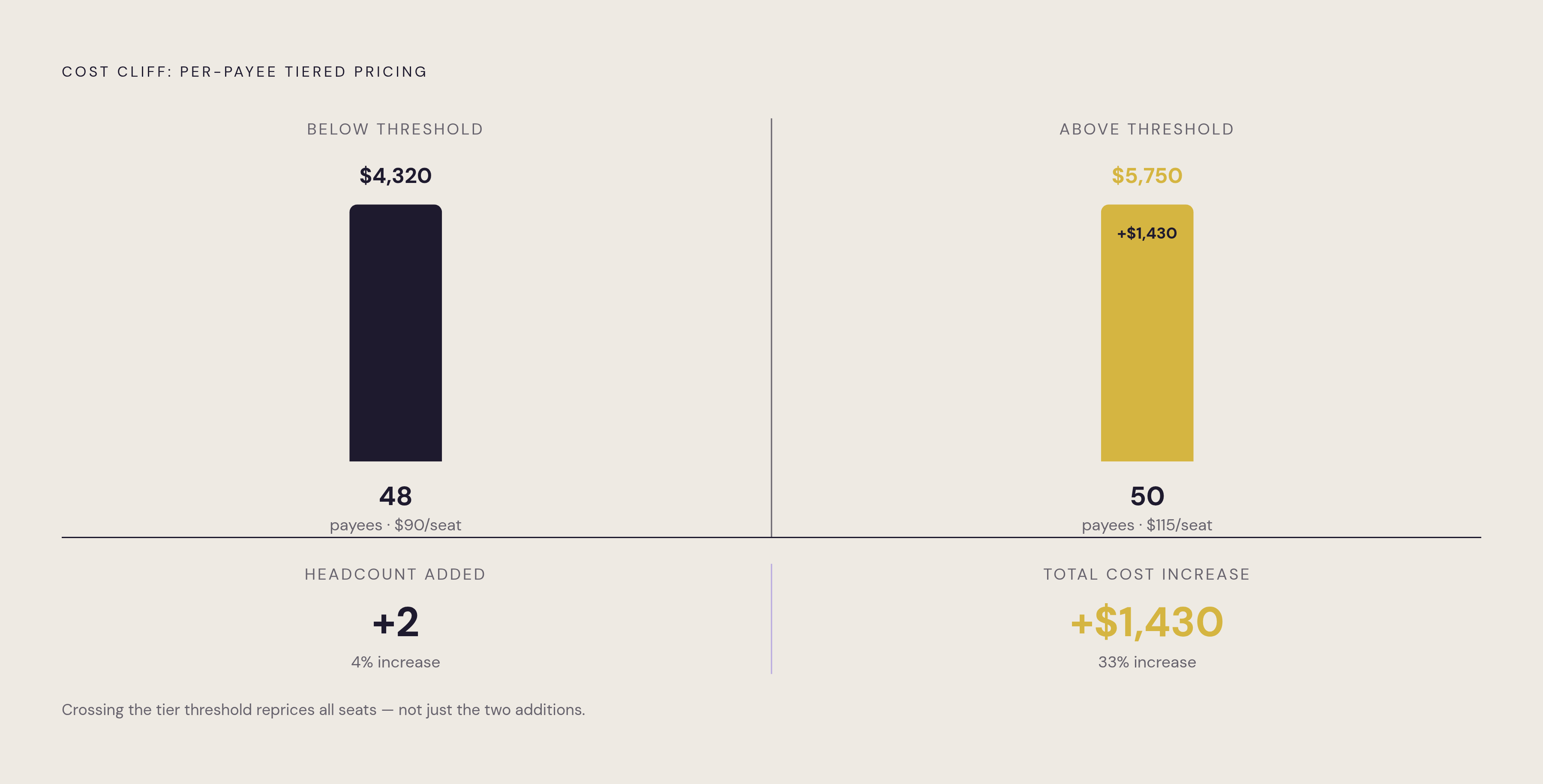
A tiered per-payee contract can turn a small increase in headcount into a much larger change in software cost. The critical distinction is whether crossing a threshold changes the rate only for additional payees or reprices the entire payee population. In the latter structure, a company sitting just below a boundary can enter a materially more expensive bracket by adding a small number of reps. The increase extends beyond the new hires.
Workable’s ATS pricing illustrates the same mechanism in an adjacent software category. Its pricing scales on total employee headcount rather than recruiter seats, with headcount thresholds moving the whole account into a new pricing band. In both cases, the number of people counted sets the account’s bracket, even if the buyer first focuses on the quoted price. A commission contract that applies a new rate to the entire payee count creates the same exposure through a different metering unit.
The timing of that threshold crossing compounds the increase. A successful recruiting quarter can move the company into a higher bracket mid-year, while the new AEs and SDRs are still ramping. Because those reps need time to become productive, the expanded software bill can arrive before an equivalent revenue uplift.
What the cost spike does to Finance and RevOps mid-cycle
Finance absorbs that event after the operating plan is already in motion. A budget sized for stable headcount may have no corresponding line item for a move into a higher commission software tier. Meanwhile, RevOps is onboarding new payees, re-forecasting quotas and configuring the commission process for a larger team. The timing is particularly difficult for both functions. Hiring raises the bill while taking up the time the teams need to review and manage it.
RevOps also faces a cost that does not appear on the vendor’s invoice. Where people still do commission work by hand, more payees mean more work, so the software bill and the time spent on that work can rise together. During a surge, the team may still be setting up new reps’ plan terms when it needs to prepare accurate payouts. Finance therefore confronts an expanded software commitment while RevOps has less room to absorb the work that accompanies it.
New AEs and SDRs take months to reach full productivity, but the applicable per-seat fees can increase before those reps generate the revenue against which the spending was justified. Finance is managing both a software cost event and a quota attainment lag. Neither is independent of the hiring plan. Treating the invoice as an isolated procurement issue obscures the fact that the spending and revenue effects arrive on different schedules.
There is also a compliance dimension for the CFO. Under ASC 606, incremental commissions on new contracts must generally be capitalised and amortised, unless the amortisation period would be one year or less, when a practical expedient permits immediate expensing. A hiring surge can multiply the commission records subject to that treatment. Manual or under-resourced processes become harder to defend in an audit as that population grows. The accounting requirement adds pressure to the teams handling the pricing cliff’s consequences.
The shelfware trap that follows the surge
Seats purchased for a hiring wave can remain as shelfware after attrition, performance management or a territory restructure reduces active payees. Annual commitments can keep the company from releasing those seats mid-term. The contract remains anchored to peak headcount. The company may then pay for payee slots that provide no commission calculations or business value for the rest of the contract year.
This is the second dimension of headcount-based pricing risk. During expansion, the company pays more because more reps are eligible to be counted, while after contraction it may continue paying for capacity it no longer uses. Sales organisations have churn, so even after a strong hiring quarter, some of the seats bought may end up empty. A model that appears to track usage closely at purchase can therefore become disconnected from actual usage in both directions, through tier repricing on the way up and committed seats on the way down.
Why headcount growth and commission accuracy problems arrive together
The same surge that exposes the pricing model also strains the commission process. A larger payee population means more calculations must be completed correctly, often under time pressure and with new reps whose plan terms are still being configured. RevOps is extending the process to more people for a higher software fee at the moment when configuration and onboarding demands are also increasing.
For new hires, this pressure coincides with their first commission statements. Errors at that point can damage trust and retention because the reps have no history of correct payments against which to judge the discrepancy. Their first experience establishes the process’s credibility. When a new hire cannot reconcile a statement, the problem is therefore more than an adjustment to a payout.
Shadow accounting makes that loss of confidence visible. Reps who maintain private spreadsheets to verify what they are owed are duplicating work that the commission process is meant to resolve. That behaviour creates both a trust problem and a productivity leak. For new hires, private reconciliation can become part of their working routine from the outset. The organisation then pays for commission software while salespeople spend time maintaining a separate view of their earnings.
CRM data quality is a prerequisite for avoiding that outcome. A commission platform can only calculate accurately from the deal data it receives, and batch sync patterns introduce a specific timing risk. A deal closed at the end of the month may not reach the commission system until after the period locks, forcing a retroactive adjustment. The correction adds work that no one budgeted time for. A process manageable with five reps can become chaotic with fifty, just as the payee-based contract moves into a more expensive bracket.
What to ask about pricing before signing a commission software contract
The practical response is to test the pricing model against a realistic growth scenario before signing. Finance and RevOps buyers should work out the total first-year cost, including implementation and professional services, as well as check the per-seat licence line. They can then use that starting cost to judge later changes. The next question concerns the thresholds themselves. At what headcount does the price change, and does the new rate apply to every payee or only to additions above the boundary?
The billing trigger deserves equally precise treatment. Buyers should ask whether a rep counts as a payee when hired, when first paid a commission or at some other event. That distinction determines when hiring enters the software bill. It is especially relevant while new reps are ramping and have not yet reached full productivity. Finance needs to know what makes each person billable to use a headcount forecast to work out when commission software costs will arise.
Buyers should establish how the vendor handles a mid-year surge that crosses a tier boundary. Buyers should ask whether the uplift is prorated or applied to the full remaining contract term, and have the treatment explained against the hiring scenario being evaluated. Timing belongs in the commercial assessment. A rate can appear manageable in isolation while its application creates a substantial unplanned commitment. Understanding the treatment before signing makes the exposure visible while the contract terms can still be negotiated.
The same scenario should also cover a later drop in active payees. Can seats be released mid-contract after attrition, or does the company remain committed to peak headcount for the full term? This is a capacity question. It establishes whether the contract can follow the sales organisation down as readily as it follows it up.
How do you avoid paying more for commission software every time you hire a new rep?
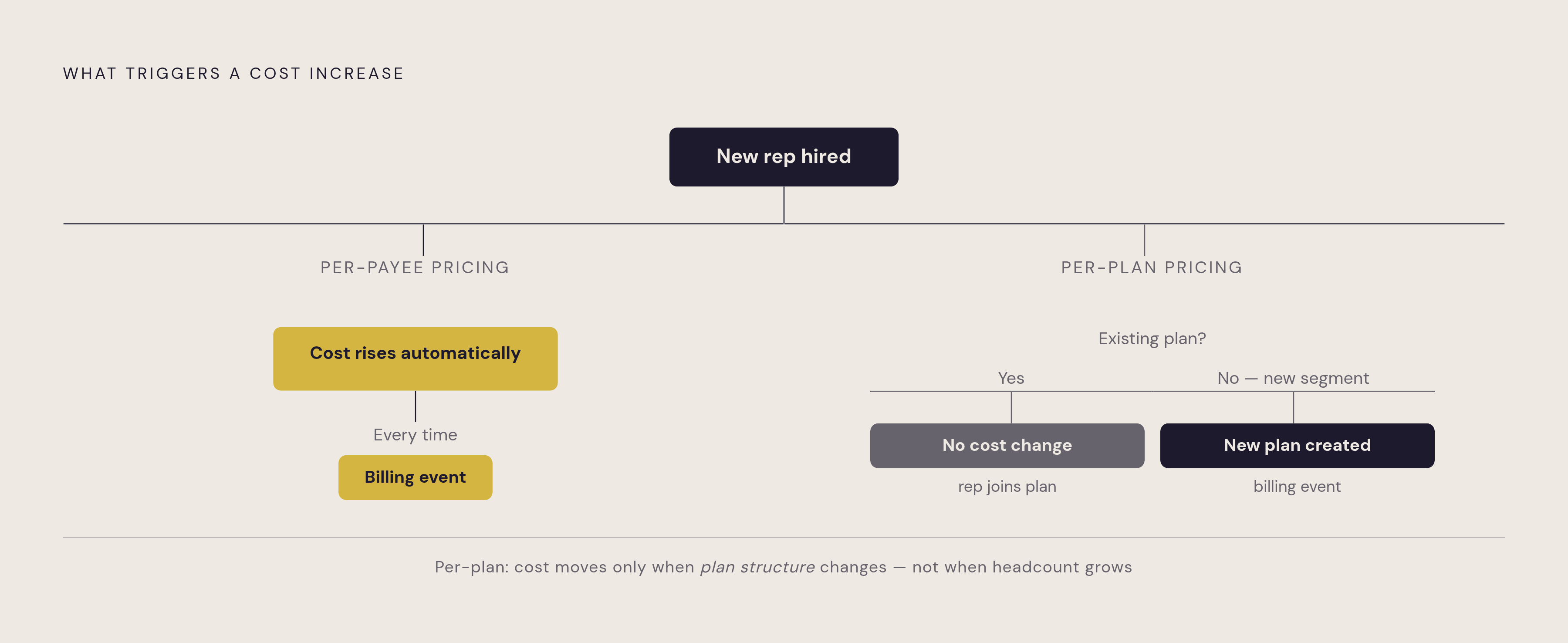
Per-plan commission software pricing separates the charge from the number of people receiving commissions under an existing plan. The bill is based on compensation plans rather than payees, so additional reps do not automatically trigger additional seat fees. The pricing unit is the distinction. Per-payee pricing links cost to the payout population, while per-plan pricing links it to building, maintaining and running compensation plans.
Finance can plan software spending around the roadmap for compensation plan design, independently of a hiring forecast that may change. Adding reps under an existing plan does not add a new pricing unit. Redesigning compensation for a new segment or product line, by contrast, can introduce additional plans and a corresponding cost. That is an expense tied to a change in what the platform manages, rather than an automatic consequence of filling another sales role.
Buyers should also look for audit trails and locked pay periods, which support governance as the payee population expands. CRM-native or flexible data import helps deal data reach the commission engine without someone having to move it by hand. Rep-level earnings visibility and deal-level statement detail give new hires a way to verify their pay without shadow accounting. Encryption and org-scoped tenancy help protect sensitive compensation data as there is more of it to protect.
Auditability, data access and statement detail support a commission process that must remain dependable as the team grows, while per-plan pricing removes the automatic connection between another rep and another software charge. Both deserve scrutiny before purchase. The resulting buying criterion is precise, which is whether the contract charges for changes to compensation plan structure or simply for more people participating in it.