
Salesforce CRM to Commission Software Integration Patterns
How you connect Salesforce to commission software determines if reps get paid correctly.
Salesforce records the moment a deal closes. It does not, and cannot, decide what that deal is worth to the rep who closed it. Tiered rates, accelerators, clawbacks, territory splits: none of that logic lives in the CRM, and none of it should. It belongs in a separate commission system. Every commission calculation depends on a connection between two platforms that were never designed to share a brain. How that connection is built shapes whether the number on a rep's statement matches the number in their pipeline. Treating that connection as a quick setup task produces errors that look like bad commission software, when the actual fault sits in the pattern feeding it data.
Companies have three broad ways to wire Salesforce to a downstream system: prebuilt connectors, custom-built APIs, and middleware. Each supports a different kind of data movement: straight synchronization, automated business processes, or on-demand data access without a full copy. Picking among them is not a matter of taste. It depends on how much flexibility a team needs, how much ongoing maintenance it can absorb, and how simple the rollout has to be to get finance and sales operations to trust it on day one.
Salesforce's own event infrastructure has changed what "good enough" looks like. Platform Events, Change Data Capture, and the Pub/Sub API now let you deliver data in near-real-time for workloads that used to need overnight batch jobs. That raises the bar. A team evaluating integration patterns today is choosing against a wider set of real options than it would have five years ago, and a wider set of options means more chances to pick one that doesn't fit the commission plan it has to support.
The three primary integration patterns for commission workflows
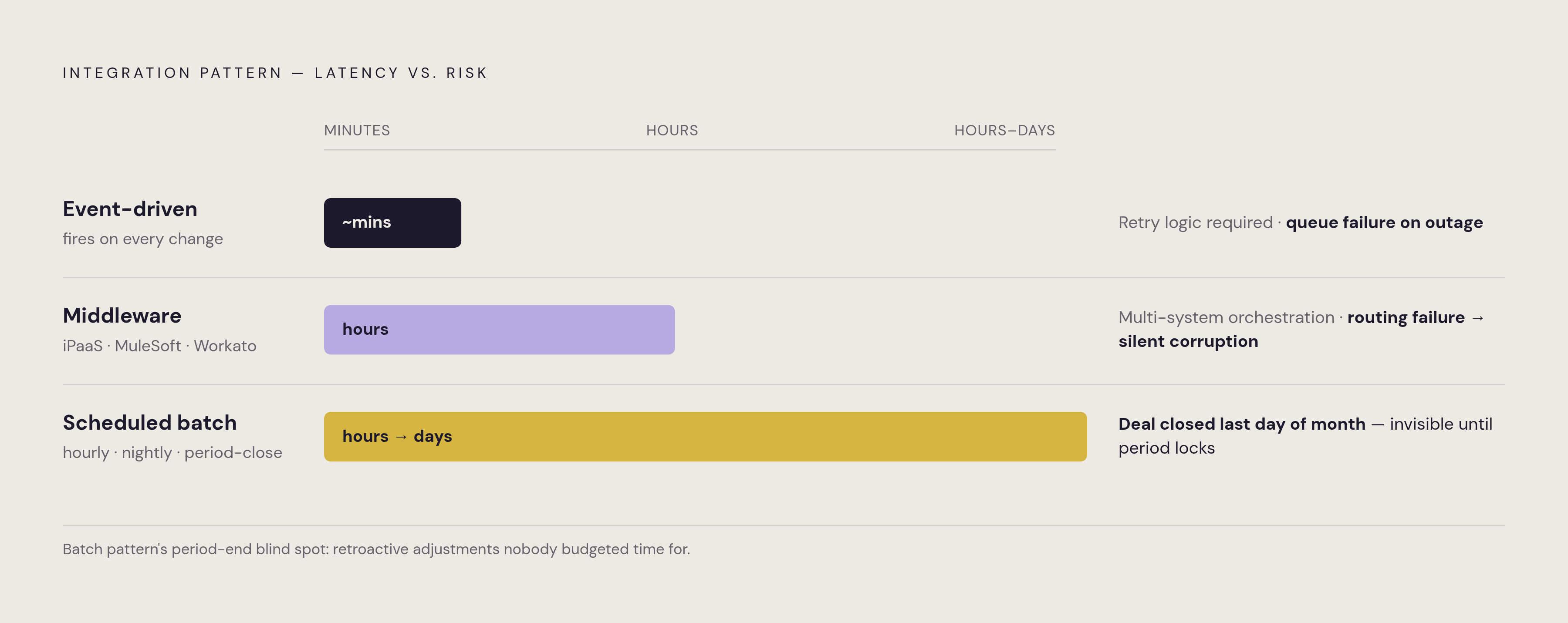
Three patterns dominate how Salesforce actually gets connected to a commission system: event-driven, scheduled batch sync, and middleware-brokered. Each trades timeliness against complexity and resilience differently, and that tradeoff decides how well a commission plan performs in practice.
Event-driven integration fires the moment something changes in Salesforce: a deal closes, a stage updates, a contract amount gets revised. The commission system receives that signal and processes it right away, rather than waiting for a scheduled job to pick it up. This pattern earns its keep when someone genuinely cannot wait for an answer. Reps checking live commission dashboards fall into that category: with event-driven sync, their earnings reflect a closed deal within minutes rather than the next morning, which is the only way "real-time commission visibility" becomes an actual feature instead of a line in a sales deck. It isn't free of risk. Holding a connection open means that if the receiving system is slow to respond, that latency compounds. And Salesforce caps the default org allocation for externally delivered Platform Events within a rolling 24-hour window, so teams running high deal volume need to plan for that ceiling before they hit it mid-quarter.
Scheduled batch sync moves data on a timetable instead of record by record: hourly, nightly, or only at period close. For plans where commission runs once a month and nobody needs to see numbers mid-period, batch sync does the job without the overhead of maintaining an event pipeline. But when a deal changes mid-month and triggers a retroactive adjustment, the commission system won't see it until its next scheduled run. Batch sync fails quietly, too: a poorly planned schedule doesn't collapse all at once, it drops one mismatched record at a time, and by the time someone notices, the cost of fixing it has already outrun the cost of planning it correctly the first time.
Middleware-brokered integration, sometimes called iPaaS, puts a platform such as MuleSoft or Workato between Salesforce and the commission system. That middle layer translates formats, routes events, applies transformation logic, and handles retries when something downstream fails. It functions as an orchestration layer for organizations juggling dozens of specialized tools at once, and it earns its complexity when Salesforce data has to reach an ERP, HCM, or billing system in the same transaction. For commission workflows specifically, middleware matters most when the calculation depends on data scattered across systems, say, a commission rate set partly by contract terms sitting in a billing platform and partly by rep tenure recorded in an HCM system. The cost of that capability is a new dependency: if the iPaaS platform has an outage, or a routing rule misfires, the commission system can receive corrupted or incomplete data with no immediate signal that anything went wrong.
Few commission implementations rely on just one of these patterns. A common setup pairs event-driven sync for deal closes with batch reconciliation for period-end payroll exports, so each pattern covers the part of the workflow it's built for. Most real projects settle into two or three patterns working together.
How commission workflow requirements should drive pattern selection
The right pattern is the one that matches what the commission workflow actually demands at each stage: how data enters the system, when calculations need to run, how much visibility reps require, and how period-close approval gets handled.
Event-driven integration fits your team if reps get paid on deal close and need to track their own quota progress in real time. Shadow accounting, the habit of reps keeping their own commission spreadsheets outside the official system, starts the moment they stop trusting the official number, and real-time data is the most direct way to prevent that habit from forming. High-velocity sales organizations face a related problem with nightly batch jobs: during an active selling period, a once-a-day sync can leave the commission system consistently behind the CRM by a meaningful margin. Accelerator-based plans raise the stakes further. Knowing the moment a rep crosses a quota threshold changes how they sell for the rest of the period, and that behavioral signal disappears if the underlying data sits stale for hours.
Scheduled batch sync is the right call for plans that don't need that level of immediacy. Teams running simple, monthly commission cycles that aren't reviewed until period close don't lose anything from batch latency, because nobody is checking intra-period numbers anyway. Large-volume data migrations and first-time loads from a CRM into a new commission system also favor batch sync: the priority there is accurate reconciliation at scale, not instant accuracy. And organizations without the API capacity or engineering staff to maintain an event-driven pipeline are better served by a batch sync that works reliably than a real-time connection that breaks silently under load.
Middleware becomes necessary once a commission calculation needs inputs from more than one source system: Salesforce for deal data, a billing platform for contract terms, an HCM system for rep start dates or territory assignments. It also fits organizations facing high CRM costs or needing workflow customization that a prebuilt connector simply can't capture, because off-the-shelf connectors are built for common cases, not the specific logic of a given commission plan. Enterprises that need commission data to flow downstream into ERP and payroll as part of one orchestrated transaction, rather than a separate manual export, are also squarely in middleware territory.
A requirement that applies regardless of which pattern a team chooses underlies all three: accurate Salesforce data is a precondition for accurate commission calculations. A familiar failure in CRM adoption is that reps skip required data-entry steps because nothing stops them. If you enforce stage-based deal workflows and require key fields before a deal can be marked closed, the data flowing into the commission system stays complete from the start. No integration pattern fixes an incomplete source record after the fact. The pattern determines how fast a bad record travels downstream; the record's existence traces back to the source.
Commission Accuracy and Dispute Volume by Pattern
Integration latency and incomplete data are the direct cause of the commission disputes and shadow accounting that erode the relationship between sales and finance.
Shadow accounting is a behavioral response to a data problem, not a discipline problem. When reps stop trusting what they'll actually be paid, they build their own tracking systems so they have evidence ready the moment they need to dispute a number. A single bad commission calculation can fracture that trust, and once it's broken, reps start keeping independent records as a matter of course. The integration pattern feeding the commission system is usually to blame. If that system lags the CRM by hours or days, reps will notice a mismatch between what their CRM pipeline shows and what their commission statement says, and they will assume the statement is the one that's wrong.
A commission platform can only be as accurate as the CRM data arriving in it, which places two demands on the integration pattern at once: deliver that data promptly, and enforce its completeness at the source. Batch sync patterns are especially exposed to a specific failure that happens at the worst possible time: a deal closed on the last day of the month may not appear in the commission system until after the period has already locked, forcing a retroactive adjustment and a re-approval cycle that nobody budgeted time for. Event-driven patterns largely avoid that scenario, but they carry a different risk. If the commission system goes down during a high-volume deal day and events queue up without delivery confirmation, calculations can come out silently incomplete unless the system has retry logic and gap-fill mechanisms built in to catch what was missed.
None of this gets fixed by a better dispute-resolution interface. Tickets, real-time commenting, and email notifications only resolve disputes efficiently if the data underneath them is already complete; built on top of a poorly integrated feed, a dispute tool resolves the symptom while leaving the actual cause untouched. Team-selling environments compound the risk of inaccurate commission calculations. When multiple roles share credit on a single deal, the integration has to carry the credit split, role assignments, and overlay designations along with the deal value, and those fields are often the ones left incomplete or entered inconsistently in Salesforce. Ambiguous credit attribution is already a common source of compensation disputes on its own, and the integration pattern decides whether the right fields even make it to the commission system or whether only the deal total does.
Audit trails and period locking for finance and compliance
Everything above is a sales operations concern. It's also a finance and compliance concern, because the integration pattern shapes whether commission data holds up to audit. Auditors care about traceability, timestamps, and whether a record was locked in a way that survives scrutiny months or years later.
CRM systems that drive commission calculations can fall under SOX requirements once they hold information relevant to financial reporting controls, and the connection between Salesforce and the commission platform belongs to that control chain just as much as anything else in it. Compliance expectations have shifted away from static, point-in-time documentation toward continuous data verification: auditors increasingly want ongoing proof that financial data stays accurate across every system it touches, not just a clean snapshot taken once a quarter. SOX also requires organizations to retain audit records for a defined number of years from the end of the fiscal period in which the audit or review concluded. That requirement means the integration has to produce records that stay immutable and time-stamped well after the fact, not just accurate at the moment a calculation runs.
End-to-end traceability means being able to prove a commission calculation from the originating CRM event all the way through to the payroll export, with every step along the way verifiable, secure, and time-stamped. Event-driven patterns build that trail almost automatically: each event carries its own timestamp, payload, and delivery record, and when paired with a commission platform that locks pay periods and logs approvals, the full chain from deal close to payment stays traceable without extra effort. Batch sync patterns are harder to audit at that level of detail. A batch record shows what was included in the run, but it doesn't always show which specific CRM event triggered that inclusion or what state the record was in at the exact moment the batch executed. Middleware-brokered patterns can produce strong audit trails too, but only if the middleware is explicitly configured to log every transformation it performs. If middleware routes data without logging those transformations, it leaves gaps in the audit chain that nobody finds until an auditor goes looking for them.
Organizations managing ASC 606 commission reporting or facing external audits need to check that their commission platform actually supports historical integrity, approval evidence, period-end reporting, and commission capitalization workflows, because the integration pattern is the mechanism that generates the evidence behind all four. Audit-ready reporting that pulls data automatically from source systems and applies commission rules without manual handling cuts down on the human error that creates compliance gaps in the first place, but that only holds if the data arriving from Salesforce is complete and arrives in the correct sequence. When a third-party commission system plays a role in a material financial process, the risks tied to that system and the controls meant to compensate for them need to be clearly understood. Those risks are most likely to appear in the integration layer connecting it to Salesforce, without anyone noticing until it's too late to fix quietly.

