
Tiered Commission Rate Design and Retroactive Accrual Problems
Retroactive tier designs create dramatic commission swings that Finance must forecast, not discover.
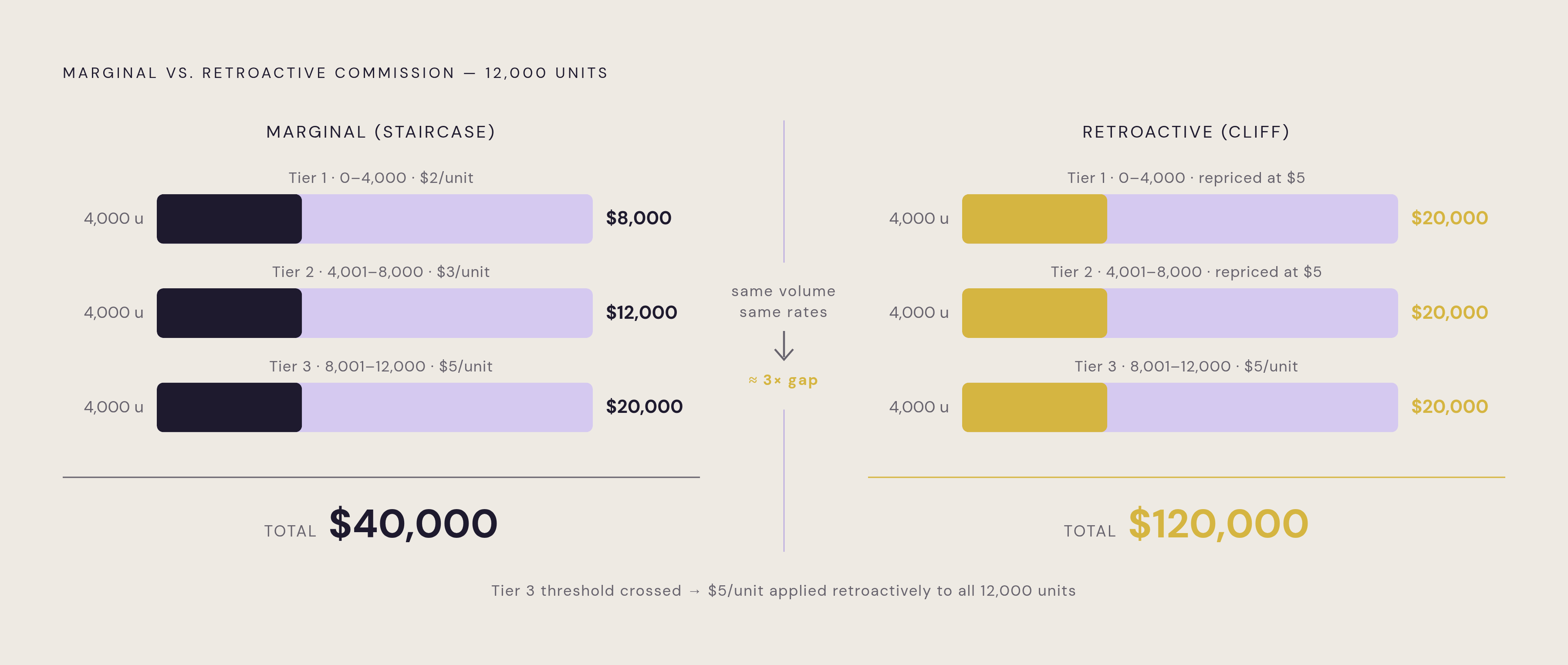
A tiered commission plan looks simple on its face: sell more, earn at a higher rate. But buried inside every one of these plans is a decision that determines more about rep earnings and Finance's liability than any other. It is the question of whether crossing a threshold reprices all revenue in the period, or only the revenue above that threshold. Most plan documents never name this choice explicitly. The clause specifying a percentage rate after a revenue threshold is ambiguous on whether it means marginal or retroactive, and that ambiguity carries a cost that lands in the worst possible place: after the quarter closes, when Finance discovers what the plan actually meant. The same sales volume, the same rate schedule, and the same rep can produce materially different commission totals depending on which model is in force. The gap is not trivial. The same purchase volume produces a roughly 3x difference in cost between an incremental and a retroactive structure, a difference that belongs in plan design decisions, not reconciliation surprises.
How marginal and retroactive tiers actually calculate
Marginal and retroactive tiers are not variations of the same formula. They are different calculation rules that produce structurally different payout curves, and the distinction becomes clear the moment the arithmetic is laid out. Under a marginal, non-retroactive structure, only the portion of sales above a threshold gets the higher rate, much like an income tax bracket. Sales below the threshold keep the lower rate. Under a retroactive, cliff-based structure, once a threshold is crossed the higher rate applies to all sales in the period, including those already counted at the lower rate. A third model, the milestone bonus, leaves the underlying rate unchanged and pays a fixed one-off amount when the threshold is crossed. It is useful when the company wants to reward volume without restructuring the rate itself.
Take a simple three-tier ladder and a buyer at 12,000 units. Under marginal arithmetic, the buyer earns the Tier 1 rate on the first band, the Tier 2 rate on the second band, and the Tier 3 rate only on the units above the final threshold. The total is the sum of each band calculated separately. Under retroactive arithmetic, crossing that final threshold at 12,000 units means the Tier 3 rate applies to everything, all 12,000 units, not just the slice above the line. In B2B SaaS tiered plans, this is often described as the "cliff" model versus the "staircase" or graduated model. The distinction has material financial impact, and it is the foundation on which every downstream consequence rests.
Why retroactive tiers create the motivational intensity Finance pays for
The retroactive model's volatility is inseparable from its motivational power. The cliff that makes Finance nervous is the same mechanism that drives rep effort near period-end, and it is worth understanding that mechanism on its own terms before judging it. The goal gradient effect, the well-established tendency for people to accelerate effort as they approach a goal, fires at each tier threshold in a tiered structure, not just at the final target. Under a retroactive model, crossing a threshold reprices the entire period, creating a dramatic, visible jump in earnings that a marginal structure cannot replicate at the same threshold point. That jump is the point. A retroactive tier creates a strong incentive to reach the threshold precisely because the payoff reprices everything already earned, not just the next dollar. The marginal structure blunts this incentive at the exact moments when peak effort is most valuable, in the final stretch before a tier boundary. For the rep sitting just below a threshold in the last week of the quarter, the marginal incremental dollar is unremarkable. Under the retroactive model, that same push reprices the entire quarter. The strongest objection to retroactive tiers is accrual unpredictability, and the practitioners who favor them argue that this behavioral intensity justifies that complexity. Their position is defensible, provided Finance pre-models the cliff scenarios rather than treating them as surprises.
What the cliff does to Finance's accrual position
The motivational argument has a direct financial consequence. Under a retroactive structure, a single threshold crossing by a single rep does not add marginal commission liability. It reprices the entire period's commission, creating an accrual spike that cannot be smoothed at month-end. When a rep crosses a threshold, the calculation engine must query all prior transaction records for the period, sum previously applied commissions, and calculate the catch-up difference. This is not an additive update. It is a full retroactive recomputation. Commission expense must be recognized, and for multi-year contracts amortized, in alignment with the periods over which the related revenue is recognized. Under generally accepted accounting rules, that alignment is not optional. Finance cannot wait for the cliff crossing to happen. It must estimate whether each rep will cross before the period closes, because a late-period surge can retroactively swing large amounts of liability with little warning. This is why retroactive ladders demand tighter accrual discipline throughout the period.
The accrual problem compounds when multiple reps approach a threshold simultaneously. Each individual crossing is a manageable event, but a cohort crossing together produces a correlated spike that flat-rate accrual assumptions do not capture. One strong month can cost significantly more than planned if several reps land just over a threshold at the same time. Budgeting for the cliff is not a luxury. It is the discipline the structure requires. Using the maximum tier rate as a default accrual assumption overstates liability, while a probability-weighted estimate based on each participant's actual trajectory is more accurate and produces smoother period-end financial reporting. The cliff is a calculable event. Finance's job is to model it, not to be surprised by it.
How period choice multiplies the operational stakes of the model you pick
The measurement period is not independent of the tier model. It determines how often a cliff can occur, how large the repricing event is when it does, and how much behavioral distortion accumulates at period boundaries. Monthly tiers work well for high-volume transactional sales but carry high end-of-month stress and deal-timing manipulation risk. Quarterly tiers reduce short-term manipulation and align with budget cycles. Annual tiers suit strategic, long-cycle sales but require strong forecasting. Under a retroactive model, a monthly period means the cliff can be crossed, and accrual repriced, multiple times a year per rep. A quarterly period reduces frequency but increases the size of each potential cliff event, since a larger pool of revenue is eligible for repricing. The distortion takes two directions at period-end. Reps near a threshold push volume across regardless of deal quality. Reps who cannot reach the next tier in the remaining time stop trying for the period. Both are predictable consequences of the retroactive model at short measurement windows. A marginal structure eliminates the repricing event entirely, but it also eliminates the behavioral spike that justifies the retroactive model's complexity. Period-length decisions therefore carry less motivational weight under marginal designs.
Plan language that resolves the ambiguity before it reaches payroll
Most accrual and dispute problems traceable to tiered commission structures originate not in the math but in plan language that fails to specify which model is in effect. The remedy is a plan document that treats the tier structure as a calculation rule, not a summary of intent. The document must explicitly distinguish marginal bands from a retroactive threshold. If the next rate reprices all eligible revenue, the plan must say so explicitly and model the resulting payout. It must also specify which period determines attainment, what happens at the exact threshold value, how corrections and returns affect tier placement, and which version of the plan governs a closed period when plan terms change mid-year. Treat the plan as a versioned set of rules. Preserve the terms and effective dates used to calculate each closed period instead of editing historical rules in place. The test is practical. A rep should be able to explain what earns commission. Finance should be able to reproduce the amount. An auditor should be able to trace that amount to the source event and the exact rules in force at the time. If the plan language cannot support all three, it is not yet a calculation rule.
Why spreadsheets structurally cannot handle retroactive tier recalculations
The retroactive tier model is not just harder to calculate in a spreadsheet. It requires a capability spreadsheets structurally lack: requerying and repricing a closed set of transactions when a threshold is crossed mid-period. NetSuite's native commission module cannot handle the most common enterprise structure, where hitting a new tier re-rates all prior revenue at the higher rate. Commission managed via spreadsheets and CRM exports aggregates numbers into a single per-rep payout for payroll, which destroys the underlying deal-level attribution required for financial reporting and audit defense. When a spreadsheet manages a retroactive plan, the recalculation typically happens manually at period-end. The accrual estimate and the final payout are calculated by different people at different times using potentially different data. That variance is what shows up later as a reconciliation problem. The same manual process that produces the payout error also destroys the audit trail. Without a locked, timestamped record of which transactions were in scope when the tier was crossed, there is no defensible basis for the commission figure.
What a calculation system needs to handle both models correctly
A commission platform capable of handling tiered plans, retroactive or marginal, needs capabilities that go beyond rate tables and CRM integrations. It needs deal-level transaction records that remain queryable within a period. The retroactive model requires re-rating all prior transactions when a threshold is crossed, which means the system must hold the full transaction set in a state that can be repriced without manual re-entry. It needs a calculation lock mechanism that prevents double-processing of the catch-up delta when a tier boundary is crossed mid-period. It needs a timestamped audit trail that records which transactions were in scope, which plan version was in force, and who approved the locked period, so Finance can defend the accrual figure and reps can see the deal-level basis of their statement. It needs plan versioning that preserves the rules used to calculate each closed period, so mid-year plan changes do not retroactively alter historical payouts. It needs rep-facing visibility into current tier position and projected payout, so reps can track their own trajectory without shadow accounting and the behavioral mechanism of the tier model can function as designed. The practical optimum is 3 to 5 tiers. Fewer than 3 provides insufficient differentiation. More than 5 creates confusion and administrative complexity. A platform should be able to configure and calculate across that range without custom engineering. The structural decision between retroactive and marginal tiers determines how much reps earn and how much liability Finance must accrue. A system that can handle both models correctly is what turns that decision from a source of variance into a lever of design.
