
Migrating Commission Calculations From Excel to Dedicated Software
Hidden spreadsheet errors create silent commission miscalculations that compound at scale.
Excel commission spreadsheets fail because of how they are built. Three structural vulnerabilities account for most of the damage. The first is formula fragility: a single overwritten cell, a broken reference, or a VLOOKUP missing its FALSE argument will pass its error silently through every downstream tab, with nothing in the workbook designed to flag the corruption. The second is the absence of any real version history. The spreadsheet that calculated last March's payroll cannot be reconstructed once thousands of subsequent edits have piled on top of it, and that leaves audit defensibility at effectively zero.
The third vulnerability is a missing paper trail for human intervention. When someone manually adjusts a rep's commission in a way that changes the payout, the workbook keeps no record of who made the change, when, or why. That absence converts every manual override into an unverifiable event, one that neither the rep nor the auditor can ever trace back to its source.
The failure mode that does the most damage rarely looks like a crisis. It tends to be a quiet one-to-two percent drift between what reps were actually paid and what they should have been paid, building for a full year before anyone notices the gap. Ray Panko's research and the European Spreadsheet Risks Interest Group's catalog consistently find that more than ninety percent of non-trivial spreadsheets contain at least one material error, and commission spreadsheets are especially vulnerable because they combine high transaction volume, multi-tab formulas, hand-keyed data entry, and small-team ownership.
Scale is what turns a tolerable risk into an active liability. A spreadsheet built for a handful of reps on one or two simple plans can run for years without visible trouble. Adding a few dozen reps across multiple plans causes the model to strain. Pushing past that, especially with mid-year plan changes layered in, causes the workbook to produce numbers that are wrong without anyone realizing it, because nothing in the file is built to catch its own errors at that volume.
The exposure does not stop at accuracy. Multi-state minimum wage and labor law variation turns a commission miscalculation into potential litigation, and accounting standards ASC 606 and ASC 340-40 require deal-level attribution for the capitalization and amortization of contract acquisition costs, a level of granularity that an aggregated spreadsheet payout simply cannot preserve. A final, quieter risk is that the workbook usually depends on one analyst who understands its logic well enough to keep it running. When that person leaves, the knowledge leaves with them, and rebuilding the model's logic from scratch can take months, precisely the situation a structured migration is designed to prevent.
What a migration involves
Moving commission calculations off a spreadsheet is a data and logic transfer project. It is a data and logic transfer project, and it runs in four distinct phases, each carrying its own failure mode that costs real money when skipped or rushed. A workable version of this project runs on a ninety-day clock: discovery from day one to day twenty-one, build and configuration from day twenty-two to day fifty, a shadow run from day fifty-one to day eighty, and cutover with decommissioning from day eighty-one to day ninety.
Each of those four phases gets its own detailed treatment further in this piece. What matters at the outset is the mental shift the project demands. Teams that treat this as a purchase decision, something resolved once a contract is signed and a vendor account is provisioned, consistently underestimate the work ahead. Teams that treat it as an operational project, with gates that have to be met before moving forward, tend to get through it without a payroll incident.
The most common underestimation is running one shadow cycle instead of two and mistaking a single match between systems for a validated process. A single cycle can agree by coincidence, matching on a data set that happens not to contain the edge case that would expose a flaw. Two consecutive cycles agreeing to within one dollar is the actual gate before cutover, and that standard exists because it is hard to satisfy by accident. The other common mistake is leaving the spreadsheet live after the new system goes into production, which creates a second, competing source of truth and undoes the audit clarity the migration was built to establish. Both mistakes are avoidable, and both are addressed directly in the phases that follow.
Phase one: building a data dictionary that surfaces every hidden formula before migration begins
Discovery is the phase most teams shortchange, and it is the one whose shortcuts are hardest to undo later, because logic that gets migrated incorrectly simply becomes the new system's undocumented logic instead of the old one's. The output of discovery has to be four concrete artifacts that give the team documented proof of its own commission plans.
The first artifact is a plan inventory: one row for every plan variant, broken out by role, segment, and geography, capturing effective dates, OTE, quota, base commission rate, accelerators, and any special conditions attached to that variant. The second is a data dictionary proper, with one row per input field, recording the source system that field comes from, how often it refreshes, who owns it, and what should happen if the field arrives empty. The third is a calculation map: a dependency diagram for each plan, tracing the path from raw deal data through to the final commission figure, with every manual intervention in that path called out explicitly. The fourth is an edge case log, cataloging every piece of special handling the spreadsheet's author currently performs by hand. Those manual handling cases are the specific points where a migration is most likely to go wrong.
Most spreadsheets carry at least one formula nobody fully understands, and a study cited widely in data quality literature found nearly 30% of spreadsheet data contains errors, so discovery is the phase built to surface that unexplained formula and force a written account of what it does, before the logic gets carried into a new system rather than after.
Commission inputs rarely live in one system. CRM records, ERP data, billing platforms, subscription systems, and manual adjustments all feed into the calculation, usually from different owners on different refresh schedules. Discovery's job is to map every one of those sources, note who owns each one, and record how often it updates, so the new system can be configured to draw from the same authoritative origins rather than from a spreadsheet's stale copy of them.
A thorough readiness assessment pulls together existing capability records, workflow charts, a review of past error patterns, an accounting of where time actually gets spent maintaining the current process, and a clear list of the operational pain points the team already knows about. A gap in any one of those inputs becomes a configuration error once the build phase starts, because the build phase can only encode what discovery managed to document. Skills belong on this list too: whether the organization currently has the technical capacity to design, implement, and maintain the new platform, and whether any gap gets closed through hiring, training existing staff, or bringing in an implementation partner, is a decision that needs to be made before the build begins, not discovered midway through it.
The data dictionary functions as the migration's insurance policy. Everything configured in Phase 2 is only as accurate as what the dictionary captured in Phase 1. Deferring the same work to the shadow run phase means the same undocumented formula appears there anyway, except now against live production data and at a higher cost to fix.
Phase two: configuring the new system and reconciling it against the spreadsheet before anyone goes live
The build phase is complete only when every discrepancy between the new system's output and the spreadsheet's output has been investigated, explained, and written down. Configuration that happens to land on the right total through the wrong underlying logic will hold up right until a plan condition changes, at which point it produces a wrong answer with no way to trace why.
Plans get encoded using the artifacts produced in Phase 1. Source data feeds get connected, CRM for deal data, billing systems for revenue, HRIS for the rep roster, and test calculations run against historical data get reconciled row by row against what the spreadsheet produced for the same period. The reconciliation is the actual center of gravity in this phase. Every row where the new system and the spreadsheet disagree gets investigated until the specific cause is identified. Most of those discrepancies turn out to be errors in the spreadsheet itself rather than errors in the new configuration, and both categories need to be written down, not simply corrected and forgotten. The build phase closes with a documented sign-off stating that the system reproduces the spreadsheet's commissions within an agreed tolerance and that every remaining difference has an explanation attached to it.
That one percent agreement threshold is not an informal estimate. It functions as a documented gate that the project does not pass through until it is met, and finding spreadsheet errors during this reconciliation step is a sign the process is working as intended.
CRM integration belongs in this phase as a structural fix. It replaces the manual CSV export and copy-paste workflow that introduced data errors into the spreadsheet in the first place. A direct connection to Salesforce or HubSpot lets deal data flow into the calculation engine automatically, which establishes a single source of truth for the input data that commissions are calculated from.
Every complex plan feature needs testing against real conditions in this phase: tiered rates, accelerators, SPIFs, clawbacks, splits, and mid-year plan changes should all be configured and run against the actual historical scenarios that triggered those conditions in the past. An accelerator rule that has never been tested against a real deal that went over quota is a configuration assumption waiting for its first live test, and the build phase is where that test needs to happen, not after cutover.
Running two parallel shadow cycles
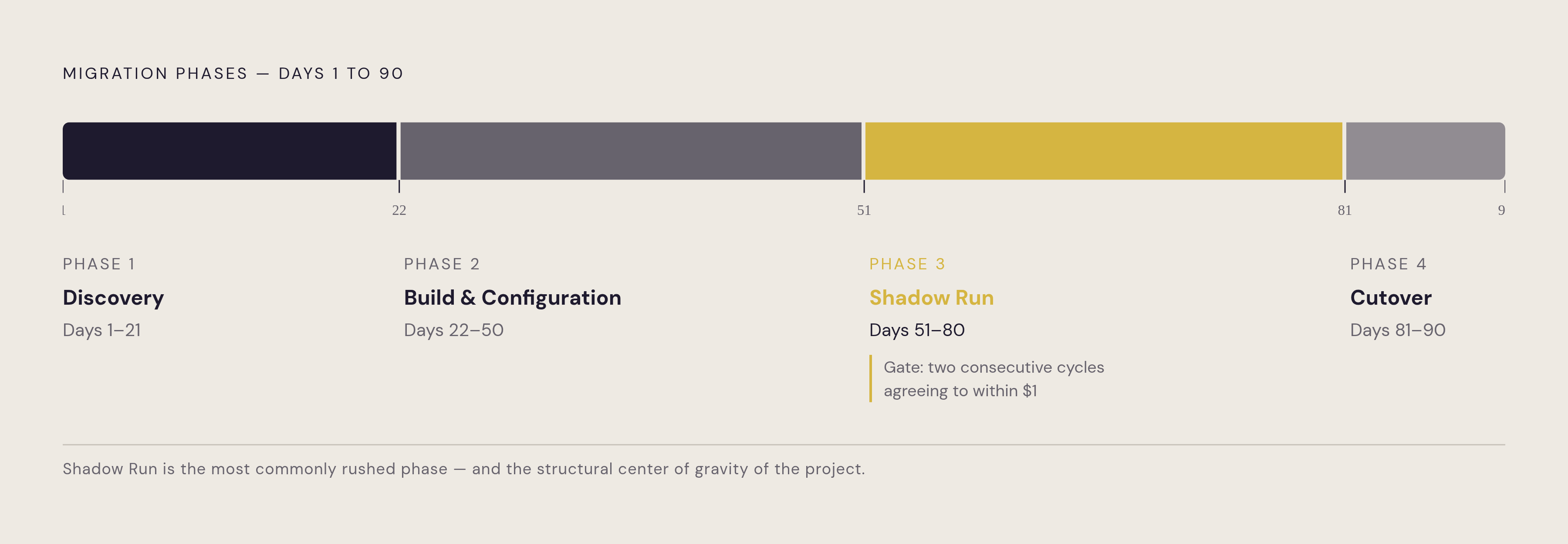
One parallel cycle proves very little on its own. Two consecutive cycles producing the same result is what constitutes a validated process, and the distinction carries real weight because a single cycle can match by chance on a data set that never happens to exercise the edge case a second cycle would expose.
The shadow run consists of two consecutive, complete commission cycles run against live production data, with the spreadsheet still serving as the official system of record while the new system calculates the same cycle in parallel. Every difference larger than one dollar between the two gets investigated. This phase accomplishes three things that no earlier phase can reach. It confirms the new system produces the right answer under actual production conditions rather than curated test data. It gives the comp administrator practice running the new system with no payroll risk attached, since any mistake made during a shadow cycle never touches a real paycheck. It also exposes the edge cases that historical data never contained in the first place: a new product SKU added the previous month, a rep on parental leave whose plan needs proration, a deal split three ways between reps who each need their own share calculated correctly.
The one-dollar tolerance is a deliberate line, not an arbitrary one. Rounding differences are explainable and acceptable within that margin. Anything larger requires a written account of what caused it and how it was resolved before the cycle can be marked closed.
When the two systems disagree, the investigation follows a specific sequence. The first step is identifying whether the discrepancy originates in the input data, such as a mismatch between a CRM feed and a manually entered figure, in the calculation logic itself, or in how a plan term got interpreted. The second step is documenting that resolution and, where a plan interpretation turned out to be ambiguous, updating the calculation map built back in Phase 1 so the ambiguity does not resurface. If the same type of discrepancy occurs again in the second cycle, that repetition is evidence of a structural cause, and it needs to be fixed before cutover rather than accepted as an acceptable known variance.
This phase also creates a low-risk opportunity to build trust with the sales team. Reps can see a preview of what their statements will look like, including deal-level drill-down and quota progress visibility, before any of it affects an actual paycheck. That preview period lets reps get comfortable with the new format on their own time, with the spreadsheet still officially governing their pay until the shadow run has proven itself.
Phase four: executing a clean cutover and decommissioning the spreadsheet permanently
Cutover marks the point at which leaving the spreadsheet alive becomes the greatest remaining risk in the entire project, because a file that can still be edited will eventually get edited, and a second live source of truth undoes the audit trail the whole migration exists to build.
The cutover checklist has six concrete requirements. The system-of-record date gets documented and announced to every stakeholder involved. The spreadsheet gets locked to read-only and archived with its version metadata intact, never to be edited again. The first statement generated by the new system goes out to reps with a clear announcement that this is the new statement of record. The comp administrator keeps dual-system access for thirty days after cutover, strictly for historical lookup rather than active use. The audit log inside the new system gets enabled from day zero. Finance and Sales Ops both sign off on the first close run entirely through the new system.
That first statement should look familiar to reps, since its numbers already match what the shadow run produced. It should also offer capabilities the spreadsheet never could: deal-level drill-down into how a commission was calculated, a visible audit trail, and pay periods that lock once closed so figures cannot be altered retroactively.
A rollback plan has to exist before cutover happens, not get improvised during a crisis after it. That plan documents the specific condition that would trigger a return to the spreadsheet, names who has the authority to make that call, and spells out how data generated by the new system would be reconciled back if a rollback ever became necessary. A written rollback plan gives stakeholders the confidence to commit to a firm cutover date.
ASC 606 compliance takes effect at cutover, not before it. The new system has to preserve deal-level attribution, not just aggregated per-rep payroll totals, so that the incremental costs of obtaining a contract can be capitalized and amortized correctly. The audit log and the locked pay period are the structural proof that the migration succeeded. They demonstrate not only that the new numbers match the old ones, but that the process generating those numbers can now withstand an audit, a labor dispute, or a finance team's year-end close, in a way the original spreadsheet never could.

