
Draw Against Commission Structures for New Sales Hires
New hires need income before their commissions materialize; draws bridge that timing gap.
A new hire's revenue contribution and their need for income sit on two completely different timelines, and closing that gap is the entire reason a draw against commission exists. Reps generally need several months to build pipeline substantial enough to generate real commission, with ramp windows running roughly three to six months depending on role and industry, and performance keeps developing well past that point. That timing mismatch occurs in three recurring situations: the onboarding stretch when a new rep's pipeline is still thin, seasonal periods when deal volume predictably slows, and long B2B sales cycles where months separate a first meeting from a closed deal. Putting a rep on commission-only pay during any of those stretches replaces the incentive to sell well with the incentive to sell fast: discounting to close anything available, cherry-picking easy deals over strategic ones, and rushing prospects who need more time. Base salary alone doesn't fix this either, because a fixed paycheck removes the performance incentive at the exact moment a growing sales organization needs its newest reps building disciplined habits. A draw against commission sits between those two failure modes, giving a new hire a financial floor while keeping the variable pay that keeps selling behavior aligned with the business. It functions as a bridge across the ramp period rather than an added perk layered on top of a comp plan.
What a Draw Against Commission Is
A draw is an advance against commissions a rep hasn't earned yet, not a bonus, and that distinction determines how the whole structure gets administered and how reps come to trust or distrust it. Each pay period, the rep receives a fixed draw amount up front. At the end of that period, the company calculates actual commissions earned and subtracts the draw already paid out. If commissions exceed the draw, the rep gets the difference on top of what they've already received. If commissions fall short, a shortfall exists, and what happens to it depends entirely on which type of draw governs the agreement.
A simple example makes the mechanic concrete. Say a rep receives a $3,000 monthly draw. In month one, deals close slowly and the rep earns only $2,000 in commission, a $1,000 shortfall against the draw already paid. Under a recoverable draw, that $1,000 carries forward as a balance the rep owes the company. In month two, the rep's commission exceeds the draw: the prior balance is deducted first, with the remainder paid out above the draw.
The draw is not a salary. It doesn't accrue benefits the way base pay does, it's tied directly to commission performance, and every term governing it, recoverable or not, the length of the draw period, and what triggers reconciliation, needs to be spelled out in a written agreement before the rep starts. Commission total minus draw amount equals commission owed. A positive result means a surplus paid to the rep. A negative result means a shortfall, and how that shortfall gets treated is what separates the two core draw structures.
Recoverable vs. Non-Recoverable Draws
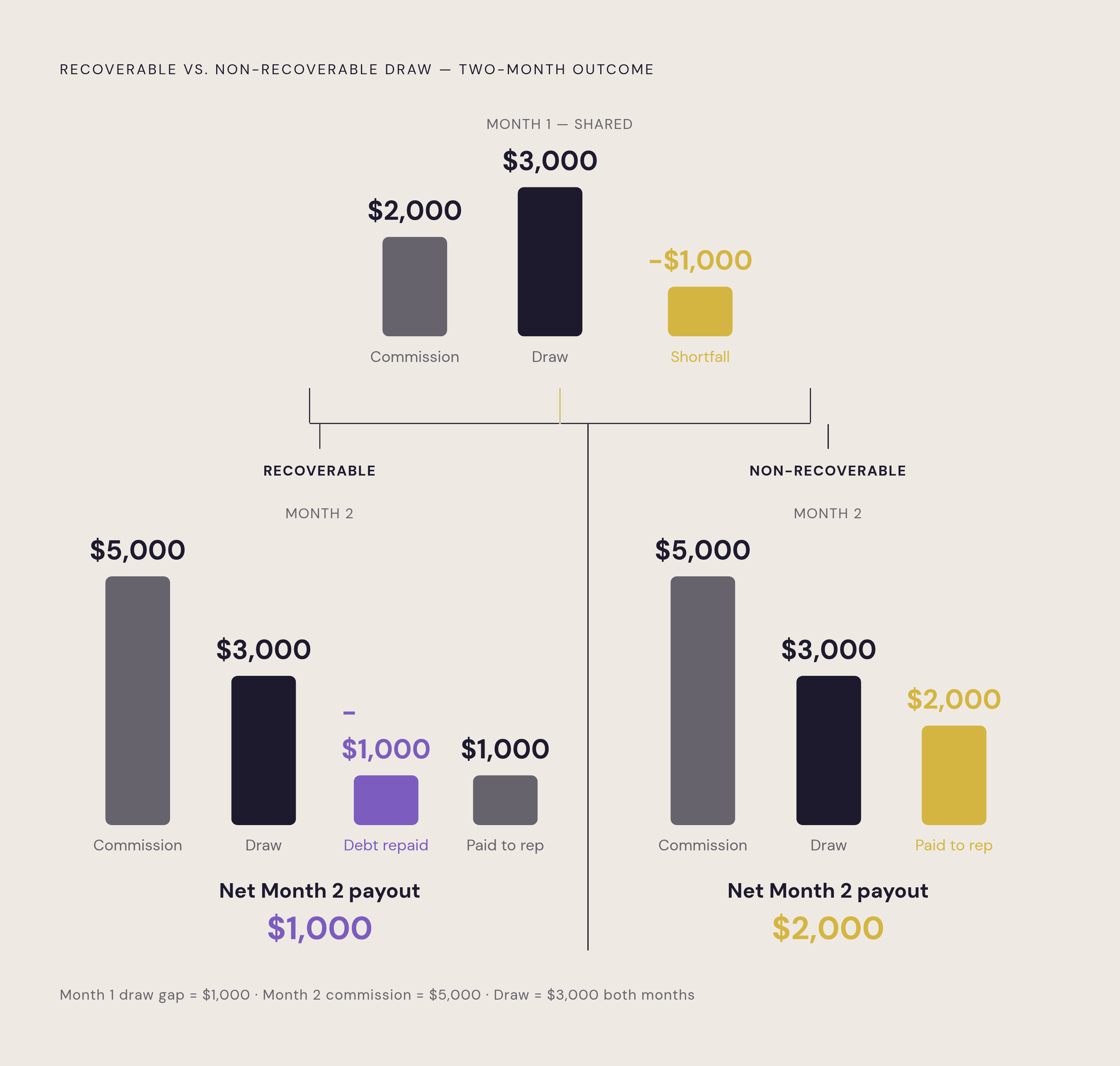
The choice between a recoverable and a non-recoverable draw is a decision about who absorbs the financial risk when a new hire's commissions come in under the draw amount. That allocation carries consequences well beyond a single paycheck: it shapes how a rep behaves under pressure, how likely they are to stay through a rough quarter, and how much exposure finance carries on its books.
Under a recoverable draw, any shortfall between the draw and earned commission becomes a balance owed, deducted from future commission checks until it's cleared. Risk sits primarily with the rep. This preserves accountability, but it can also produce a debt spiral: a rep who struggles for two or three consecutive months accumulates a balance heavy enough to push them toward short-term, deal-at-any-cost selling, or toward resignation, rather than toward the kind of patient, strategic pipeline-building the company actually needs from them. Recoverable draws work best for experienced reps stepping into established territories with predictable sales cycles, where the draw functions as a short bridge rather than a long-term safety net.
Under a non-recoverable draw, a rep who earns less in commission than the draw amount simply keeps the full draw, no payback required. The company absorbs the difference. Risk shifts almost entirely to the employer. In exchange, non-recoverable structures tend to produce lower early-stage attrition, stronger results in recruiting and offer acceptance, and reps willing to pursue larger, slower-moving enterprise deals without the anxiety of a growing balance hanging over them. This structure fits new hires during ramp, reps working sales cycles longer than six months, and teams entering new markets where no historical performance data exists to set a fair benchmark.
The same two-month scenario used earlier shows the split clearly. A rep short by $1,000 in month one either carries that shortfall forward as debt (recoverable) or keeps the full draw with the shortfall forgiven outright (non-recoverable). In month two, when commission exceeds the draw, the recoverable structure deducts the prior shortfall first and reduces the net payout, while the non-recoverable structure pays out the full commission with no prior balance applied at all. Whichever type a company chooses has to appear explicitly in the written offer. A rep who discovers after the fact that their draw is recoverable, when they believed otherwise, has grounds for a dispute that a clear agreement would have prevented.
Recoverable versus non-recoverable draws for new hires
Three variables determine which draw type fits a given hire: how long the ramp period realistically runs, how predictable the rep's territory and pipeline are, and how much financial exposure the company can absorb if the hire underperforms.
Non-recoverable draws fit best in a few specific situations. A hire who is genuinely new to sales, or new to the company's product and market, faces a ramp timeline that's inherently unpredictable, and saddling that person with accumulating debt before they've had a fair shot at performing is punishing rather than motivating. Long sales cycles present the same problem in a different form: in B2B, real estate, or financial services, months can pass before a first close, and a recoverable balance building silently across that stretch breeds resentment rather than urgency. A company entering a new market without historical performance data faces a third version of the same issue, since there's no benchmark for what a reasonable ramp even looks like, which makes a recoverable structure structurally unfair to whoever gets hired first.
Recoverable draws remain the right tool in other circumstances. An experienced rep moving into an established territory with proven demand should ramp quickly, and a short recoverable bridge is a reasonable ask precisely because accountability makes sense once the pipeline and process are known quantities. A company transitioning an existing rep from a guaranteed-salary role into a commission-heavy structure can also use a recoverable draw as a temporary cushion, preserving the performance incentive while easing the transition.
The strongest objection to non-recoverable draws is financial exposure: if a new hire underperforms chronically, the company absorbs every dollar of the shortfall with no mechanism to recover it. That objection has a direct answer. A non-recoverable draw period should be time-bounded and tied to the defined ramp window rather than left open-ended, and the cost of losing a new hire early because a punishing recoverable balance drove them out typically exceeds the cost of forgiving a few months of shortfall, given that the cost of replacing a failed hire runs well above that hire's annual on-target earnings. Neither structure is universally correct. Whichever one gets chosen for a given role has to be written into the offer letter in plain terms, specifying the type, the period, and the reconciliation rules, so there's no ambiguity for the rep signing it.
Setting the draw amount and defining the terms that make it work
A draw program tends to fail when the terms around it are left vague, regardless of which type got chosen. The draw amount, the draw period, and the reconciliation rules all need deliberate, documented decisions before a hire ever signs.
Setting the draw amount starts with a basic goal: the figure should approximate what a rep needs to cover living expenses and stay focused on ramping, not so generous that it functions as a windfall, and not so thin that the rep is second-guessing their finances every week. A useful reference point is the rep's target monthly commission once fully ramped, discounted to reflect realistic attainment during the ramp period itself, which keeps the draw tethered to actual future earnings rather than an arbitrary number pulled from a template. The draw amount should also sit below the rep's target on-target earnings. A draw set equal to full OTE removes the incentive to close anything at all, since the rep is already being paid as if they had.
The draw period needs to match a realistic ramp timeline rather than an arbitrary calendar quarter. Three months is a common anchor for inside sales roles, while longer cycles of six months or more suit enterprise or complex B2B positions where deals simply take longer to close. That period has to be fixed in the written agreement. An open-ended draw creates ambiguity about exactly when standard commission rules take over, which invites disputes at the worst possible moment, right as a rep is transitioning off the safety net.
Reconciliation rules round out the structure. The agreement should state how often reconciliation happens, monthly for most roles, quarterly for longer sales cycles. For recoverable draws, the agreement needs to specify how a balance gets deducted, whether dollar-for-dollar from future commissions or capped at a percentage of each check so a payout never gets reduced to zero, and whether any remaining balance gets forgiven if the rep exits the ramp period in good standing. For non-recoverable draws, the agreement should state that the draw is not owed back under any performance scenario during the defined period, and it should address what happens if the rep leaves voluntarily before that period ends.
Clawback and plan-change provisions deserve their own line in the agreement. Employers can generally revise commission plans and quotas going forward, but those changes typically can't be applied retroactively to deals a rep already closed under the prior terms. Any clawback clause, allowing the company to recover paid commission if a customer later cancels or defaults within a defined window, needs to be written into the draw agreement itself rather than introduced after the fact.
Administering Draw Structures in Spreadsheets
A draw against commission introduces running balances, period-over-period carry-forwards, and reconciliation logic that grow more complex as headcount grows, and spreadsheets have no built-in way to keep that logic consistent across every rep on the plan. A single formula error doesn't stay contained. It propagates forward into every subsequent payout calculation for that rep, often invisibly, until someone happens to notice a number that looks wrong months later.
Recoverable draw balances need to be tracked individually for every rep, across every pay period, and a manual mistake in one cell corrupts every calculation that depends on it going forward. When a rep's ramp period ends and standard commission rules take over, that transition has to be applied precisely at the deal level, and spreadsheets require someone to manually flip a flag or update a formula reference, a step that's easy to miss when a comp admin is managing the transition for several reps at once. Clawback events compound the problem further. When a customer cancels or a deal unwinds, the correction requires adjusting a prior commission record retroactively, and in a spreadsheet that usually means overwriting the original number rather than logging a separate reversing entry, which destroys the audit trail a finance team would need to explain the change later.
Commission errors touch a meaningful share of total payouts industry-wide, and the cost isn't only financial. A rep who discovers a surprise clawback or an invisible correction to a paycheck they'd already counted on loses trust in the compensation system fast, and that loss is hard to rebuild. The problem compounds for reps specifically on a recoverable draw, since they have no way to independently verify their running balance if the calculation lives entirely inside a spreadsheet controlled by finance. Visibility into that balance matters as much as the balance itself, particularly during a ramp period that's already financially stressful for a new hire trying to prove themselves.
What commission software needs to handle draw structures correctly
A commission platform handles draw structures correctly only when it can track running balances per rep, enforce carry-forward rules from one period to the next, and surface all of it to the rep in real time, rather than simply producing a final number for payroll to process.
A few capabilities separate systems built for this from systems that treat draws as an afterthought. A per-rep balance ledger needs to exist as a running, visible record, updated automatically each pay period and viewable by both the rep and whoever approves payouts, so no one is reconstructing a balance from memory or from last month's spreadsheet tab. Reconciliation rules need to be configurable rather than hardcoded, letting a comp admin set whether a given draw is recoverable or non-recoverable, define the length of the draw period, and set a deduction cap per payout check, all without needing a developer to write custom logic for each individual rep. Once a pay period closes, the draw balance and commission calculation for that period need to be locked and logged, and any retroactive correction should create a new reversing entry rather than overwrite the original record, so the full history stays auditable months or years later. Reps themselves need direct visibility into their current balance, how it was calculated, and which specific deals contributed to it in the current period, without having to file a support ticket with finance just to understand their own paycheck.
None of that works reliably without accurate, current deal data flowing in from the CRM. Native, real-time CRM sync needs to be treated as a requirement rather than a nice-to-have, because nightly batch uploads leave reps looking at stale numbers, a problem that does particular damage during a ramp period when a new hire is already watching every deal closely and needs their running balance to reflect reality, not yesterday's snapshot.
Sources
- Draw Against Commission: Guide to Sales Compensation Draws - Fullcast
- What Is Draw Against Commission in Sales? Types, Benefits & Risks
- Draw Against Commission: What It Is, How It Works, & Examples - FreshBooks
- Draw against commission: What it is and how it works | OnPay
- Draw Against Commission: What It Is and How It Works | Indeed.com
- What Is a Draw Against Commission? | Examples & More
- Non-Recoverable Draw: The Sales Rep’s Safety Net
- Non-Recoverable vs Recoverable Draw: What's the Difference?

