
Commission Calculation Validation and Parallel-Run Testing Methods
Build test cases before running calculations to catch commission errors before they reach paychecks.
Commission calculations fail quietly, and the failures compound before anyone notices them. A spreadsheet formula that misreads a tier threshold or double-counts a split does not announce itself; it simply pays the wrong number, cycle after cycle, until a rep does the math independently and files a dispute. That lag between error and detection is the actual subject of this piece: not that spreadsheets are fragile tools, but that most commission processes have no validation layer standing between a calculation and a paycheck. When a plan adds accelerators, SPIFs, or clawbacks, the underlying formula grows in complexity, but the audit trail of who changed what, when, and why does not grow with it. A spreadsheet records edits. It does not record the logic that produced them, so an error introduced during a plan change stays invisible until a rep disputes a payout.
The cost of that invisibility is not confined to the single paycheck that was calculated wrong. Rep turnover triggered by compensation disputes carries a real replacement cost per departure, and every investigation into a disputed number consumes finance team hours that recur every single cycle, not once. Left unmanaged, this produces a second, subtler failure: reps stop trusting the number on their statement and start keeping a private ledger of what they believe they are owed. That practice, often called shadow accounting, is a majority behavior among sellers. It is a majority behavior, and it exists because the organization's own validation process has failed to do the job the rep is now doing manually. The error-detection burden has moved from the finance function, where it belongs, to the individual seller, who has neither the systems access nor the formal standing to fix what they find.
None of this is a condemnation of spreadsheets as a tool. It is evidence that commission accuracy has no owner in most organizations until a human being complains. Validation, done deliberately, is what gives accuracy an owner before the complaint arrives. The rest of this piece is about what that deliberate validation layer looks like in practice: what has to happen before a single calculation is even run, and what has to keep happening after a system goes live.
How plan complexity determines how hard validation will be
Validation does not operate on compensation plans in the abstract; it operates on the specific logic a plan contains, and that logic determines how hard the job will be before anyone writes a single test case. The six commission structures in common use, flat percentage, revenue-based, gross margin, territory volume, residual, and hybrid, differ sharply in how many variables have to be reconciled per deal. A flat percentage plan has one variable to check. A hybrid plan layering accelerators on top of territory splits may carry a dozen. Every one of those variables is a place where the calculation can diverge from what the rep, or the finance team, or the system, believes is correct.
Caps, accelerators, SPIFs, clawbacks, and splits each add a conditional branch to the underlying logic, and every branch is a place where two people can read the same plan and compute a different number, which is precisely what a parallel run will expose. That divergence is precisely what a parallel run, discussed later in this piece, is designed to surface. But surfacing it late, after a transition is already underway, is far more expensive than catching it during design.
There is a deeper problem complexity can mask: a plan that is difficult to validate is sometimes also a plan that is unattainable. Fullcast's 2025 Benchmarks Report found that nearly 77% of sellers missed quota even after quotas had been lowered, and that gap between plan design and realistic attainment has to be addressed before any migration to a new system begins. Migrating a broken plan faithfully into new software does not fix it; it only automates the same mistake at higher speed. That is a design question, not a validation one, but it belongs in this conversation because a plan that cannot be clearly explained is very often a plan that cannot be clearly tested.
The practitioner test for whether a plan is validation-ready is blunt: can a rep explain how they are paid in under a minute? If not, the plan contains ambiguity that will resist reconciliation, because the same conditional logic confusing the rep will produce divergent outputs when two systems try to calculate it independently. The first act of validation discipline is documentation: converting the plan's rules into a written, unambiguous specification that a test case can be measured against. Without that specification, there is no ground truth, and comparison becomes guesswork. In practice, organizations moving from spreadsheets to dedicated commission software spend roughly one week on this documentation phase before any calculation work begins. That week is the foundation every subsequent validation step depends on.
Building test cases before running a single calculation
Building test cases before comparing any outputs at all is the most commonly skipped step in commission validation, and it has to come first. Organizations under time pressure tend to jump straight to running the new calculation and checking whether the number looks right, but "looks right" is not a standard, it is a guess, and a validation process that starts with comparison has already skipped the step that would have made the comparison meaningful.
A test case is a purpose-built deal record, either synthetic or anonymized from real data, constructed specifically to exercise one conditional branch of the plan. The rep who lands exactly on 100% of quota. The rep who crosses an accelerator threshold in the middle of a quarter. The deal that triggers a clawback. The account split between two reps. Each of these has to be worked out by hand, in advance, so there is a manually computed expected value sitting on the shelf before the system ever touches the record. That expected value is what makes the eventual comparison a test rather than an impression.
Several categories of edge case deserve explicit coverage because they fail quietly and often. Deals that straddle a pay period boundary are one; a close date that lands one day on the wrong side of a cutoff can shift a payout into the wrong cycle entirely. Reps who join or leave mid-cycle are another, and this category carries an identity problem: HRIS systems typically track a rep by Employee ID, CRM systems track the same person by email, and the billing system may use yet another identifier such as a sales username. When the identifiers used by HRIS, CRM, and the billing system do not resolve to the same person automatically, the eligibility calculation, which depends on HRIS hire and termination dates, can silently exclude or include the wrong rep for the wrong stretch of time. Multi-currency deals introduce their own edge case, since the exchange rate used at the moment of booking can differ from the rate used at the moment of payout, changing the commission base without any change to the underlying deal. Partial payments that feed residual or installment plans need their own test cases, as do SPIFs that apply only within a specific date window or to a specific product line, since a boundary condition on either the date or the product taxonomy is exactly where a formula tends to break.
The test suite is not a one-time artifact. It has to be versioned alongside the plan document itself, so that when a plan changes, the test cases change with it. The test is doing its job. It is confirmation that the plan change had the calculable effect it was supposed to have, and it is one of the few moments in this entire process where a failing test is good news.
Data reconciliation: verifying source data before trusting any output
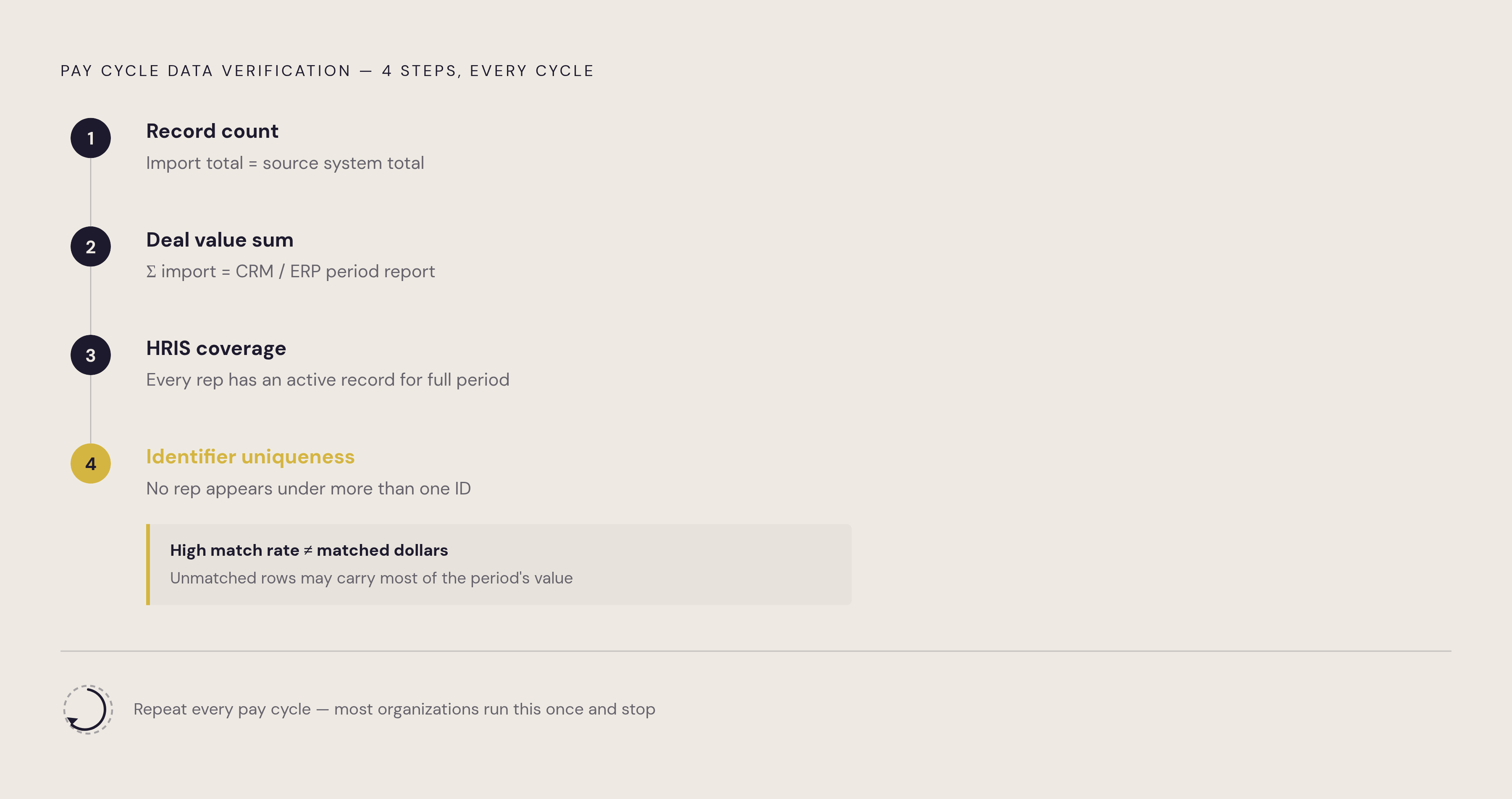
A calculation can apply flawless logic to bad data and still produce a wrong answer that passes every formula check available. That is the specific risk data reconciliation exists to close, and it sits upstream of the calculation engine entirely: no amount of test-case rigor helps if the deal record feeding the calculation was wrong to begin with.
The failure modes here are specific and recurring. A CRM deal amount can differ from the invoiced amount when a discount is applied in the billing system after the CRM record has already closed. Duplicate deal records cause a commission to be paid twice on the same sale. Missing close dates push a deal into the wrong pay period, silently shifting when, and sometimes whether, a rep gets credit. Rep attribution errors, a deal assigned to the wrong seller, or to no seller at all, produce either a missed payout or a payout to someone who did not earn it. HRIS-CRM identity mismatches, the same problem raised in the test-case discussion, break manager rollup calculations and eligibility checks whenever the systems disagree about who a person is.
A workable reconciliation sequence runs in four steps every cycle: confirm the count of deal records imported matches the count in the source system; confirm the sum of deal values matches the CRM or ERP report for the same period; confirm every rep in the pay run has an active HRIS record covering the full period; and confirm no rep appears under more than one identifier in the import. Import success rate and auto-match rate are the two operational metrics to track here, but a high auto-match rate on a large number of small-dollar deals can mask a real problem if the handful of unmatched rows happen to carry most of the dollar value in the period. Matching most of the records is not the same as matching most of the money.
Manual data entry remains the most frequently cited source of commission error, and the structural fix is reconciliation against a CRM or ERP system of record rather than a manually assembled file. That fix has to run every cycle. A reconciliation check performed once, at the start of a system's life, tells an organization nothing about whether the data feeding the calculation six months later is still clean.
Running the parallel cycle
The parallel run is the single most consequential step in any commission process transition, because it is the only technique that tests accuracy against real data under real operating conditions rather than constructed scenarios. The mechanism is straightforward: the existing process, typically a spreadsheet model, and the new process run side by side on the same input data for the same pay period, producing two independent outputs. Every discrepancy between them gets investigated and resolved before a single rep is paid out of the new system.
The minimum standard is one complete pay cycle run in parallel, though two or three cycles are warranted when different plans pay on different schedules, monthly commissions alongside quarterly ones, for example, so that every plan type gets validated before the old process is retired. Organizations transitioning from spreadsheets to dedicated commission software typically complete the full move in roughly two to four weeks: about one week for the plan documentation covered earlier, and about two weeks for the parallel-run cycle itself.
Several metrics matter during that window, and each measures a different kind of risk. Import success rate shows how many deal records loaded without error. Auto-match rate shows how many records were automatically tied to the correct rep and plan, and should be evaluated by dollar value, not just record count. Exception age tracks how long unresolved discrepancies have sat open, since a discrepancy that lingers for a full cycle is a different kind of problem than one closed within a day. Manual minutes per cycle capture the labor cost of corrections, a figure that should decline across successive cycles if the new system is actually working as intended. Reopened items and post-approval adjustments are evidence that a close was not clean the first time. Deposit-to-ledger difference measures the dollar gap between what the new system calculated and what the old process would have paid on the same data, which is the most direct accuracy signal available. Export failures track records that never made it to payroll.
Scope discipline matters as much as any metric on this list. During the parallel close, plan rules and data sources should be frozen except for defects that threaten data integrity, and any change made mid-run has to be applied to both the old and new process simultaneously or the comparison stops meaning anything. Teams under deadline pressure frequently violate this discipline, adjusting a rule in the new system to fix an apparent discrepancy without touching the old one, and then find they can no longer explain why the two outputs differ at all. A parallel run is not a formality run to check a box before go-live. Discrepancies that no test case anticipated appear in actual production data at this point, and resolving each one is itself a form of plan documentation, since it forces a definitive answer to a rule that had previously been ambiguous.
Locked-period comparisons: how to catch drift after the cutover
The parallel run validates the starting state of a new commission process. It does not guarantee that the process stays accurate six months, or six plan revisions, later. That ongoing guarantee comes from a separate and continuous practice: locked-period comparison, which catches the kind of drift that accumulates quietly after a plan gains a new territory, a new accelerator tier, or a new roster of reps.
A locked pay period is a closed, approved record in which the inputs, the specific version of the rules applied, and the resulting outputs are all frozen, changeable afterward only through a logged override. This is a governance convention whose real function is technical: it is what makes any comparison across periods meaningful. Once a period is locked, running the same input data through the calculation again in a later period should produce the identical output, unless a plan rule or a data record genuinely changed in between. Any unexpected divergence signals one of two things: either a plan change happened without being formally recorded, or the calculation engine has a defect.
That comparison only works if plan versioning is treated as a prerequisite rather than an afterthought. Every rule change, a new accelerator threshold, a territory reassignment, a SPIF that begins or expires, needs an effective date attached to it, so the system always knows which version of the rules applies to which period's deals. Audit trails that log every calculation, adjustment, and approval are what make the locked-period comparison possible in the first place; without them, there is no way to tell a legitimate plan-driven payout change apart from a calculation error.
This discipline carries a compliance benefit, even though it should not be the primary reason an organization adopts it. ASC 606 and IFRS 15 require that commissions qualifying as incremental costs of obtaining a contract be capitalized and amortized, and the audit report must demonstrate the link between a specific contract, the commission paid, and its subsequent amortization, with a locked-period record as the foundation of that report. California Labor Code separately requires that commission agreements be put in writing and that the employer obtain a signed receipt from the employee acknowledging the agreement. Storing those plan documents and acceptance records alongside the locked-period outputs simplifies the entire compliance chain, but the underlying reason to lock periods and version plans is accuracy. The audit benefit follows from getting the operational discipline right.
Transparency and the math reps can see
Rep-facing transparency is usually described as a trust-building feature, something added once the underlying calculation has already been proven accurate. That framing understates what transparency actually does. Giving reps a clear, deal-level view of their own commission statement is a validation mechanism in its own right, because it puts every single rep to work as a real-time error detector across the entire book of business.
The shadow accounting behavior described earlier in this piece, the majority of reps who keep private spreadsheets to check their own pay, already proves that this validation is happening. It is simply happening in an unstructured, invisible way that produces disputes after the fact rather than corrections before the period closes. A structured, self-serve statement that shows the deal, the specific rule applied to it, and the resulting commission line by line converts that same energy into a formal review step. Reps flag discrepancies while a period is still open, rather than after the paycheck has already landed and the conversation has become adversarial.
Organizations that introduce transparent, self-serve statements and successfully eliminate shadow accounting sometimes discover, after the fact, that those private spreadsheets had been catching real errors all along, an ironic outcome given the trust the new system was meant to build. Once the transparent statement goes live and reps stop maintaining their own private ledgers, the underlying calculation has to be right, because the errors are now visible to the rep and the organization at the same moment, and the informal second-layer check that used to catch mistakes quietly is gone. That is why the sequence in this piece matters and the order is not incidental. Transparency is safe to introduce only after test-case construction, data reconciliation, and a completed parallel run have already done the work of proving the calculation sound. Introduced any earlier, transparency does not reveal errors with nowhere to hide. It reveals them to a rep who has no formal channel yet to report them, and the organization loses the one review layer it had left.