
Commission Software That Integrates With CRMs and Exports Payroll-Ready Files
Commission software that syncs CRM data to payroll without manual handoffs.
A commission run built on spreadsheets usually depends on one person: someone exports data from Salesforce, pastes it into a master file, reconciles it by hand, and emails PDF statements to reps at the end of the cycle. That process lives in one person's head and inbox. The texture of it is familiar: six Slack messages waiting on a Monday morning, a spreadsheet that's already out of date, two hours spent untangling what changed since the last close. Commission software earns its place in a company's stack by solving exactly this handoff: taking deal data from where it already lives and turning it into a payroll-ready file at the other end, without a single person standing in the middle holding the process together. Every feature a vendor demos, whether it's a plan builder, a rep dashboard, an approval workflow, or a CRM sync, deserves to be judged by how directly it serves that one pipeline, not by how impressive it looks on its own.
How errors compound before finance sees them
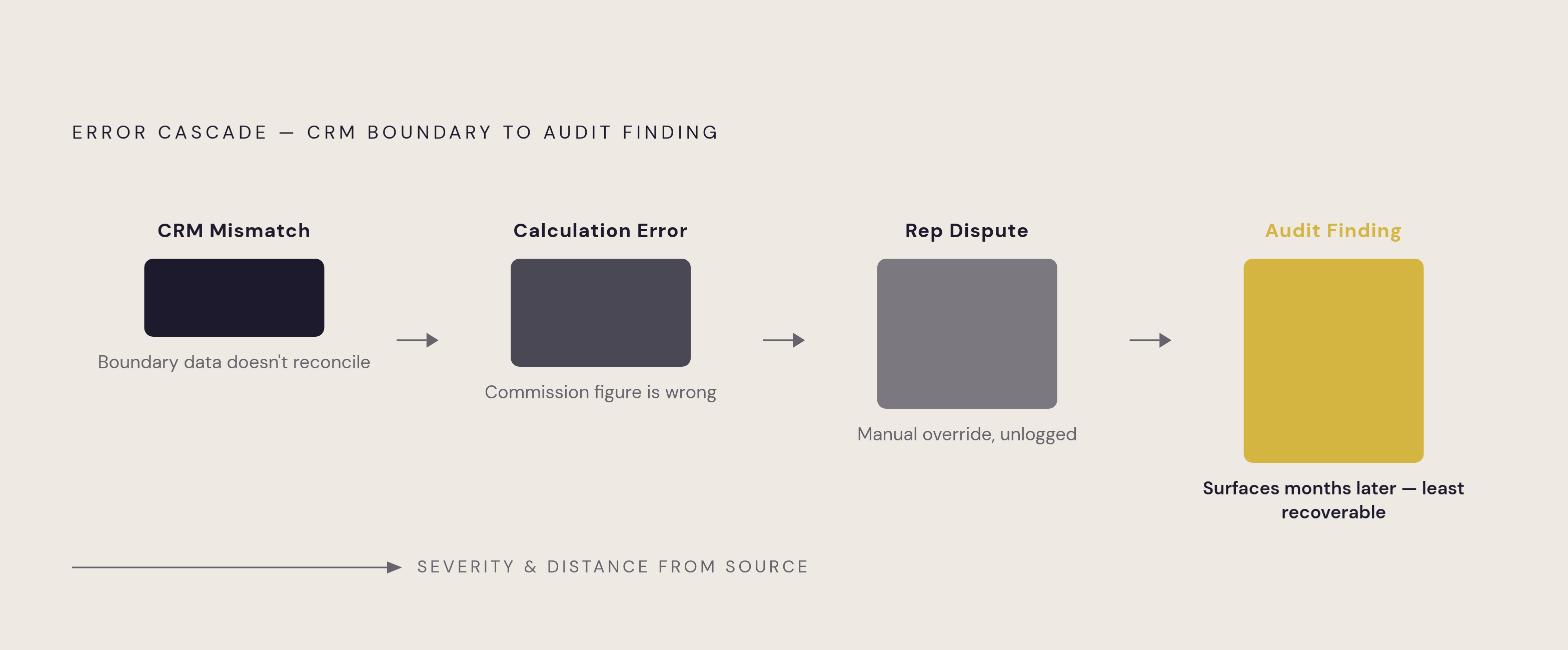
That's the structural root of commission errors, and it matters because the mistakes don't stay contained where they start. A mismatch at the CRM boundary becomes a calculation error. The calculation error becomes a rep dispute. The dispute turns into an untracked manual adjustment, and the adjustment eventually surfaces as an audit finding months later, when it's far harder to trace back to its source.
Data integrity problems start at the CRM boundary because that's where the raw material for every downstream calculation gets defined. Aggregating CRM exports into a single per-rep payout number for payroll purposes produces a clean-looking figure, but it erases the deal-level attribution that finance and auditors need to defend that figure later. Once a payout has been collapsed into one line, reconstructing which deals, at what value, on what date, contributed to it becomes a forensic exercise rather than a lookup.
Manual calculation itself carries a real error rate, and closing that gap is the primary financial argument for moving off spreadsheets and onto dedicated software. The coordination burden grows heavier as headcount rises. A single bad pay cycle, whether triggered by a plan change, a batch clawback, or a delayed trigger event, can generate a wave of simultaneous disputes across a hundred-person sales team, and untangling that wave can occupy finance and sales leadership for days.
The consequences don't land evenly. Reps who track their own commission closely, typically the top performers, notice a discrepancy almost immediately, and unexplained gaps erode trust in the compensation system faster than correct payouts ever build it back. Finance carries a separate and heavier burden: under ASC 606 and IFRS 15, commission costs can't be booked simply when cash goes out the door. They have to be amortized over the life of the customer contract, tracked through renewals, and documented well enough to survive an audit, and a manual spreadsheet process is not built to support that kind of ongoing, contract-level tracking. RevOps absorbs a third kind of cost: the reconciliation burden grows every time a new plan rolls out, a territory changes hands, or a clawback event hits the books, so the manual workload doesn't stay flat even in a stable quarter.
What a well-designed pipeline looks like: the five integration layers every platform must wire together
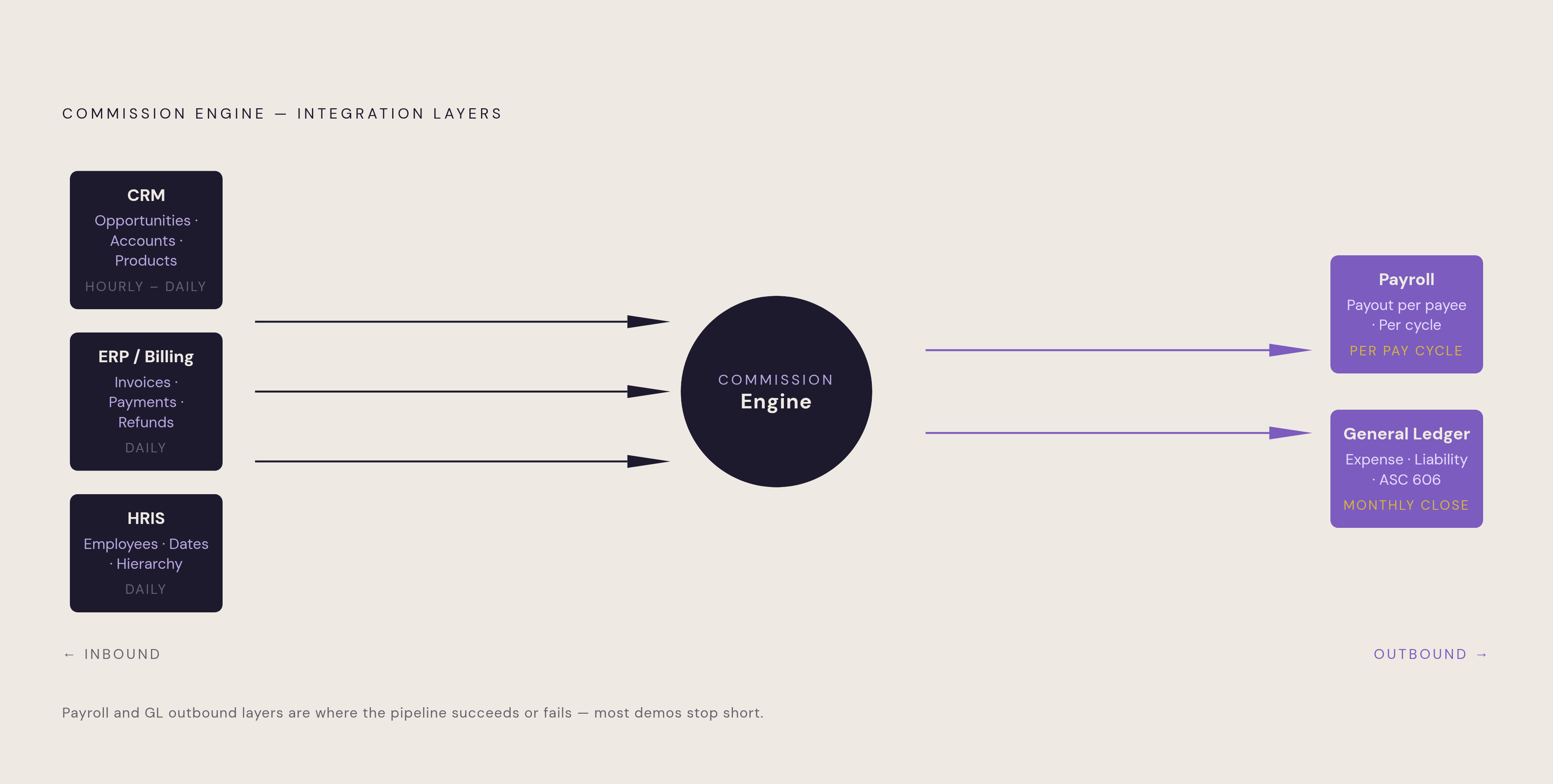
A commission engine isn't a calculator sitting off to the side. It sits in the middle of a small ecosystem of other systems, and the accuracy of anything it produces depends entirely on how well those connections are built. Five distinct layers make up that ecosystem, each with its own direction of data flow and its own update cadence.
CRM inbound covers opportunities, accounts, products, and custom fields pulled from systems like Salesforce, HubSpot, or Dynamics. A well-built integration playbook calls for syncing this layer somewhere between hourly and daily, and real-time CRM-to-commission flow is rarely worth building, since it tends to add risk rather than remove it: deals settle late, refunds arrive after the fact, and statuses keep changing for days after a deal first closes.
ERP and billing inbound covers invoices, payments, refunds, and credit memos from systems like QuickBooks, NetSuite, or Stripe, typically synced daily. This layer decides whether a commission can actually be released under a pay-on-collection plan, and it drives the automatic clawback logic that fires when a customer doesn't pay or asks for a refund.
HRIS inbound brings in employee records, hire and termination dates, and manager hierarchy from systems like Workday, BambooHR, or Rippling, also on a daily cadence. This layer makes manager rollup plans function correctly, and it allows a mid-period rep transfer to split commission credit using the HRIS's own effective dates rather than a guess.
Payroll outbound sends payout amounts per payee per pay cycle to systems like ADP, Gusto, or Paychex, and the format is not standardized: some systems expect XML, and platforms like Workday expect a direct API call. GL outbound, run on a monthly close cadence, covers the cash compensation expense, the commission liability for amounts earned but not yet paid, and the ASC 606 amortization schedule for incremental costs on multi-year deals that get capitalized and spread across the contract's life.
Three failure patterns appear only once a system is running in production. Field-name preservation is the first: if a custom CRM field gets renamed somewhere during ingestion, plan rules built around that field silently stop working, so the engine has to keep every original CRM field name available inside its own commission logic. A rep may be identified by an employee ID in the HRIS, by an email address in the CRM, and by a sales username in the billing system, and the engine needs to match on any of these consistently or risk crediting commission to the wrong record. Soft deletes are the third: when a CRM opportunity that was already credited gets marked closed-lost after the fact, the engine has to recognize that change and handle it properly rather than quietly dropping the record from its data pool.
The most underappreciated capability in the whole architecture is the cross-lookup pattern: matching an invoice ID to a deal ID, then making that deal's commission conditional on the invoice's paid status. That single mechanism is what turns a pay-on-collection plan into something an auditor can actually verify.
The payroll export problem that most integration demos skip
Every layer described so far exists to produce one final output: a file finance can actually use. Most vendor demos gloss over or skip this step. Payroll export format is not standardized across the market.
A correct export needs to carry each rep's confirmed commission amount broken out by type: base commission, accelerator, bonus, and clawback deduction, kept as separate line items rather than a single net figure. Without that breakdown, payroll processors can't apply the correct supplemental wage handling, and a mistake at this stage flows straight into a rep's paycheck.
None of that matters if the numbers reaching the export step haven't been verified first. Manager approval and statement-verification workflows have to complete before the export file gets generated, not after. Finance also needs visibility into commission accruals ahead of month-end, before the whole commission run has closed out. That distinction separates a finance team that closes its books on schedule from one that sits waiting on the commission run to finish before it can even start.
Buyers in the United States face a specific compliance checklist on top of the general architecture. Supplemental wage handling, SOC 2 Type II certification, and ASC 606 reporting make up three of five checks that a 2026 platform comparison recommends running against any shortlist, alongside payroll cycle support and US support hours. Anyone evaluating a vendor should ask to walk through a complete cycle, from a closed deal to a rep's statement to an approved payroll export, before signing anything, and should ask directly what the export file looks like and which payroll systems it connects to without a manual workaround.
How leading platforms handle the deal-to-payroll pipeline
The platforms leading the category in 2026 differ mainly in where they sit relative to the CRM and how tightly they wire the rest of the pipeline together, not in whether they can automate a commission calculation. All of them do that. What separates them is architecture and fit.
One class of platform is built to serve mid-market teams that want reps, RevOps, and finance all looking at the same set of numbers. A platform in this category might list Workday, BambooHR, and HiBob among its HRIS integrations, and position itself as CRM-agnostic with particularly strong HubSpot and data warehouse connectivity alongside standard Salesforce support. One such platform announced new capabilities in September 2026 addressing ASC 606 and ASC 340-40 reporting directly, covering the capitalization and amortization of incremental costs of obtaining a contract over its expected period of benefit, with pricing offered on a quote basis as of that same month.
A second class of platform is built around a no-code plan builder, real-time rep dashboards, and forecasting tools that let reps see projected earnings before a cycle closes. Its HRIS integrations often include payroll-adjacent systems like ADP Workforce Now, Gusto, and Ceridian Dayforce, and go-lives run through an in-house implementation team over roughly six to eight weeks, with a 2.5-month average cited elsewhere, again on quote-based pricing.
A third approach builds the commission engine directly inside Salesforce rather than connecting to it from outside. Commissions update automatically as deals move through the pipeline, which removes synchronization risk as a category of failure altogether, since there's no separate sync step to fail. Reps view their commission inside the same Salesforce workflow they already use, with statement amounts that trace directly back to the source deal record. This approach serves Salesforce-centric teams well, but offers less to teams running HubSpot, a data warehouse, or a broader modern RevOps stack. Pricing runs on an enterprise tier billed annually.
A fourth category targets RevOps and finance teams who think in spreadsheet logic natively, offering formula-based plan modeling alongside live earnings dashboards and a sandbox environment for testing plan changes before they go live. HRIS integration here often centers on ADP Workforce Now and also includes Rippling, and the platform tends to fit enterprises running complex plans, with implementation running eight to twelve weeks and quote-based pricing. One platform in this space offers an AI-powered no-code commission plan builder that simulates payouts instantly, builds complex plans visually, calculates earnings in real time, and integrates with Salesforce.
At the enterprise end, one platform serves global organizations that need maximum configurability and advanced analytics, without a published implementation timeline, on quote-based pricing. Another prices per user per month with a minimum user threshold. A separate platform advertises the fastest stated go-live in the category, at roughly two weeks, priced per user per month. Another is built specifically for mid-market and enterprise companies that need finance-grade accuracy, automating plan design, commission calculations, approvals, disputes, and ASC 606 amortization within a single system, with an implementation timeline of roughly 0.65 months stated by the vendor and quote-based pricing.
A platform built inside a single CRM removes sync risk entirely but ties a company to that CRM going forward. A CRM-agnostic platform costs a small amount of sync complexity in exchange for serving teams that run HubSpot, a data warehouse, or more than one CRM across different business units. Neither approach is wrong. The right one depends on how many systems a company's deal data actually lives in today, and how likely that number is to change.

