
Commission Accrual Entries in ERP Systems After Plan Changes
Plan changes force reopening of capitalized commissions and amortization schedules.
A mid-period change to a sales compensation plan does not simply reset the math on the next commission check. It reopens accounting positions that finance has already recorded, including accruals booked under the old plan, commission assets sitting on the balance sheet, and amortization schedules tied to contracts that haven't finished their benefit period. Under ASC 340-40, incremental costs of obtaining a contract, which includes most sales commissions, have to be capitalized and amortized over the expected period of benefit. That rule means a plan change doesn't just alter what a rep earns going forward. It can force a reopening of the amortization schedule attached to commissions already capitalized under the prior plan. A contract modification that significantly changes the expected timing of transfer of goods or services under ASC 340-40 carries its own separate requirement to reassess the deferred commission amortization period, and the two adjustments, the plan change and the modification-driven reassessment, are linked closely enough that they have to be made together inside the ERP. Finance teams who treat a plan change as a payroll event, rather than an accounting event with standards attached to it, discover the gap only when an auditor asks why the amortization schedule on the books doesn't match the compensation terms actually in effect.
The sequence of ERP entries a mid-period plan change triggers
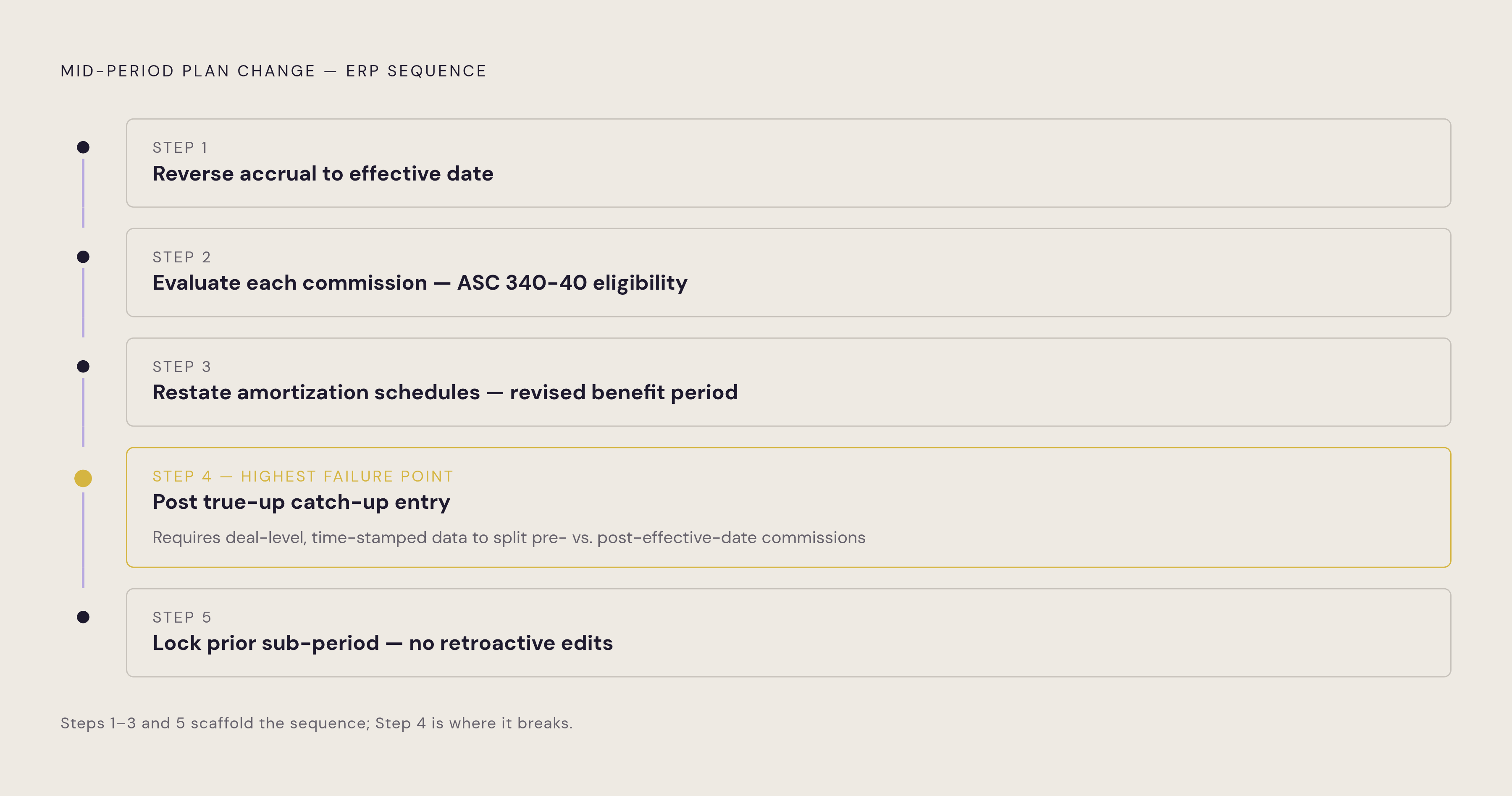
Correcting commission accruals after a plan change is a sequence, and each step in that sequence depends on the one before it being done correctly; an error early in the chain compounds across the general ledger, the deferred asset accounts, and the payroll output that reaches reps.
The sequence starts with reversing or adjusting the existing accrual. Any commission liability already recorded under the prior plan has to be reversed, or adjusted, to the exact effective date of the change. Getting that date wrong means commissions get charged in the wrong period, at the wrong rate, and every downstream entry inherits the mistake.
Once the prior accrual is settled, the new commissions earned under the revised plan need individual evaluation for capitalization eligibility. Each commission either qualifies as an incremental cost of obtaining a contract and gets capitalized as an asset, or it gets expensed immediately. The classification is not automatic. If the structure of the incentive changed along with the plan, a commission that was capitalized under the old structure might be expensed under the new one, or vice versa.
Where the plan change also modifies the expected period of benefit, perhaps shifting an incentive tied to a one-year contract into one tied to a multi-year agreement, the amortization schedule on commissions already capitalized has to be restated. That restatement runs separately from any reconciliation of capitalized implementation costs, which carry their own schedule and shouldn't be folded into the commission asset by convenience.
The fourth step is the true-up: the gap between what was accrued under the prior plan and what's actually owed under the new plan, for the portion of the period that already elapsed, gets posted as a discrete catch-up entry. This step is where the sequence is most likely to break, because it depends entirely on knowing, with precision, which commissions were earned before the effective date and which were earned after it. Without deal-level, time-stamped data, that split is a guess dressed up as a journal entry.
The sequence closes with locking the prior sub-period. Once the true-up has been posted and approved, that sub-period should be locked so that any later recalculation, whether from a disputed commission or a data correction, cannot retroactively alter a position that's already closed. Locking is what keeps step four from becoming step four again next quarter.
Spreadsheet-managed commission data and the breakdown of the sequence
That five-step sequence is tractable only when the data feeding it is structured, time-stamped, and rule-versioned. Spreadsheet-managed commissions tend to lack all three properties at once, and each missing property maps onto a specific point where the sequence above fails.
Effective-date logic, the thing step one depends on entirely, is almost always manual in a spreadsheet. There's no enforced field that distinguishes when a plan rule changed from when a payout was simply calculated. A finance team trying to reconstruct the correct accrual split ends up relying on whoever last touched the file, or on an email thread that may or may not have survived in someone's inbox.
Formula drift compounds the problem. In a shared commission spreadsheet, any user with edit access can overwrite a formula cell without the file raising any warning. A single typo in a nested IF statement can silently miscalculate payouts across an entire column of reps, and that error often stays invisible until a rep disputes a number weeks or months later, by which point the flawed accrual has already been posted to the general ledger.
Plan changes make spreadsheet-based commission tracking less reliable, because the compensation logic lives inside formulas that break the moment the underlying rules change. A mid-period plan change, in practice, means building a new tab or a new file, leaving the original rule set unversioned. That approach destroys the ability to rerun a historical calculation using the exact logic that governed a prior period, which is precisely what step three and step four require.
None of this leaves a trail an auditor can follow. Spreadsheets don't record who changed what logic, when the change happened, or what the before-and-after values were. Finance teams working from spreadsheet-based commission data cannot produce that documentation when an auditor asks for it, and they cannot defend a period-end accrual position without it. The failure isn't abstract. It traces, step for step, onto the sequence above: no reliable effective date for step one, no stable logic to re-evaluate for step two, no reconstructable history for step three, no deal-level precision for step four, and no documented basis to support locking step five.
What the ERP actually needs from the commission system to post entries correctly
An ERP cannot generate correct accrual entries after a plan change on its own. It depends on receiving deal-level, rule-versioned, time-stamped commission data from whatever system sits upstream of it, and most legacy ERP configurations were never built to produce that kind of data internally. The ERP is a ledger, not a compensation engine, and the quality of what it posts is bounded by the quality of what it receives.
The first requirement is deal-level attribution. The ERP needs to know which specific contract generated which commission amount, not an aggregate payout per rep per period. Without that granularity, ASC 606 asset capitalization, amortization calculations, and churn-driven adjustments are not solvable problems. They become approximations, and approximations don't hold up under audit scrutiny.
The second requirement is historical rule versioning. The commission calculation for any prior period has to be reproducible using the exact compensation rules that were active at that time, not whatever rules happen to be current when someone reruns the numbers. That reproducibility depends on the upstream system storing rules as structured data with effective date ranges attached, rather than as formulas that get overwritten the moment a plan changes.
The third requirement is an audit trail that can't be edited out of existence. Every payout needs a logged record of the deal data used to calculate it, the rule version active at the time of calculation, the timestamp of the calculation itself, and the identity of whoever approved it. This is the documentation finance presents to auditors, and it's also what supports a period that can be locked with confidence and reopened later through a controlled process.
The fourth requirement is integration without a manual handoff. Connecting the commission system to the ERP through an API or a structured export, rather than a manually transferred file, ensures the accrual entries get posted against the same data the commission system actually calculated. That integration closes the reconciliation gap that opens whenever two systems each hold their own version of what should be a single number.
Evaluating a Commission Platform for the Post-Change Accrual Workflow
Evaluating a commission platform for its ability to support the post-change accrual workflow means testing it against the specific steps described above, not against a features list. The criteria that matter line up directly with the sequence of ERP entries a plan change triggers.
Calculation transparency comes first. An administrator should be able to trace any single payout from the source transaction through crediting logic, rate selection, and final commission amount, not just view a total. A payout that can't be decomposed this way can't be defended in an audit or used to produce an accurate accrual entry.
Audit trail and controls matter just as much. The platform should record timestamps, users, effective dates, and before-and-after values for every plan change and every data adjustment. Prior periods should be lockable and reopenable through a controlled, logged process, not through someone editing a file and hoping the change gets noticed.
Compliance and financial reporting support is a separate evaluation category. The platform should support historical integrity, approval evidence, period-end reporting, and commission capitalization workflows built for organizations managing ASC 606 and ASC 340-40 obligations. A CFO buyer's guide recommends running one real compensation plan, including splits, holdouts, ramps, retroactive adjustments, terminations, mid-period plan changes, transactions that change after close, and multi-currency payouts, through each vendor under consideration as the actual test of vendor capability. That's the only reliable way to confirm a platform handles mid-period complexity.
Integration depth deserves scrutiny beyond the presence of a named connector. Salesforce and HubSpot connectivity cover only part of the data flow that matters here. Finance teams should evaluate ERP, billing, payroll, and data warehouse requirements directly, confirming that the full workflow operates without manual exception handling or gaps that get patched by middleware.
Security and data governance carry particular weight because commission data includes sensitive payroll and contract-level financial detail. SOC 2 Type II certification is the dominant compliance benchmark for SaaS platforms handling this kind of data, covering security, availability, processing integrity, confidentiality, and privacy. Certification alone shouldn't substitute for a detailed review of the controls that actually govern compensation calculations and the financial close process.
Governance ownership closes the evaluation. A commission platform needs a clear business owner, and Finance, RevOps, Sales Operations, and IT should agree in advance on who's responsible for plan interpretation, source data validation, calculation approval, and system administration. The accrual workflow depends on people making judgment calls at each step along the way, and the platform's job is to support those handoffs clearly and show who made which decision.
The month-end close process when a plan change has occurred mid-period
When commission data arrives at month-end already structured at the deal level, versioned by rule, and backed by an audit trail, the ERP close sequence turns into a defined checklist. Everything described in the preceding sections exists to make this phase routine.
The deferred commission asset gets reconciled separately from current-period expense. New commissions paid during the period are evaluated against capitalization criteria and either feed the asset account or flow to expense, while existing capitalized amounts are checked against the current amortization schedule for accuracy. Any schedule changes driven by the plan modification get posted before the asset balance is closed for the period.
The true-up entry is posted with supporting documentation attached. What was accrued under the prior plan and what's owed under the new plan, for the elapsed portion of the period, is posted as its own catch-up entry so it stays traceable, rather than folded quietly into the current-period accrual. That entry should reference the commission platform's locked calculation output and its approval record, so the general ledger entry carries a traceable source.
The sub-period gets locked, and the effective-date record is retained permanently. Once the true-up is posted and signed off, the prior sub-period is locked in both the commission platform and the ERP, and the effective date of the plan change is stored as a permanent field on the relevant commission records rather than living in a memo or an email that will eventually get lost.
A well-configured commission platform also supports variance analysis and forward-looking accrual estimates for the remainder of the plan period, comparing what was estimated against what was actually paid. That output gives finance real-time visibility into accrual accuracy during close. When the upstream data is clean and the platform supports the workflow described above, a plan change stops forcing a scramble through old spreadsheets and disputed numbers. The close becomes a process finance can run on schedule, defend to an auditor, and repeat the next time the compensation plan changes.

