
HubSpot Deal Data as a Commission Calculation Source
HubSpot tracks deals reliably, but commission calculation requires a layer it doesn't provide.
HubSpot deal data is a dependable foundation for commission calculation: deal amounts, close dates, ownership, and pipeline stage are all tracked accurately and in real time. What HubSpot does not provide is the calculation layer itself, and the gap between those two facts is where most commission errors, disputes, and audit failures originate.
What HubSpot deal data contains
HubSpot was built to track deals, pipeline stages, and closed revenue, and it does that job well. Every deal record carries a standard set of properties: deal amount, close date, deal owner, and pipeline stage, along with associations to company and contact records. Teams can extend this with custom properties of their own, covering anything from discount level to product line to territory. That raw material is what a commission calculation needs to start from, and HubSpot supplies it reliably.
What HubSpot does not supply is any mechanism for turning those fields into a payout. There is no native concept of a pay period that aggregates deals across a rep's book of business. There is no tiered rate logic that changes a commission percentage as attainment climbs. There is no way to split credit across multiple people on a single deal according to a compensation plan's rules, no trigger tied to payment receipt as distinct from deal close, and no mechanism for tracking a clawback when a deal unwinds. None of this is a flaw in the data. HubSpot holds the right fields in the right format; it simply has no layer sitting on top of them that applies compensation rules and produces a payout. The distinction matters because it determines where a team should look to fix the problem: not at the CRM's data quality, but at what happens to that data after it leaves the CRM.
How far HubSpot's native workarounds can take you
Most teams do not reach for a dedicated commission platform on day one. They try to solve commission calculation inside HubSpot itself, using calculated properties and workflows, and for the simplest plans, this works. A calculated property can multiply deal amount by a flat rate and pair that with a paid or unpaid status dropdown. For a single rep on a single tier with a single rate, that formula does the job completely.
The moment a plan adds a second tier, a second rep on the same deal, or a payout tied to payment receipt rather than close date, the formula field stops being adequate. Teams working around tiered or variable rates often add a manually entered commission-percentage property to each deal, then run a second calculated field off of it. That approach reintroduces the exact manual-entry error risk the team was trying to eliminate in the first place, since someone has to set the correct percentage on every single deal. Profitability-based commissions push the workaround further: margin has to be stamped up from line items to the deal record before a conditional formula can even run, and the resulting logic is hard-coded into a property with no way to version it or audit it later. Rolling individual deal-level commission amounts up into a locked, approved, pay-period total is not something HubSpot does natively at all; it requires either a third-party app or an export. Operations Hub's custom-coded workflows extend what is possible, but they move all of the maintenance burden in-house and still fall short of a commission engine's core job: applying versioned rules to a period of data and producing an auditable result.
This is a widely reported ceiling among practitioners working inside HubSpot's own community forums, not an edge case a handful of teams run into. When the native tools run out of room, the fallback almost every team reaches for next is the spreadsheet.
Why the spreadsheet fallback creates a structural problem
Exporting HubSpot deal data into a spreadsheet to finish a commission calculation feels like a reasonable stopgap, but it reintroduces every fragility the CRM was supposed to eliminate. The export is a snapshot, and the moment it is taken, it starts going stale. Any deal edit, stage change, or ownership update made in HubSpot after that export happened is invisible to the spreadsheet. The two records begin diverging immediately, and nothing in the workflow flags that divergence to the person running the calculation.
Spreadsheets used for commission calculation carry well-documented error rates, and the financial consequence is not a theoretical risk. Overpayments and underpayments at the pay-period level are common outcomes of this process, not rare exceptions. Once a rep notices, or confirms, that a statement does not match what they tracked themselves, a predictable behavior follows: they start keeping their own parallel records, a practice the industry calls shadow accounting. Shadow accounting is a rational response from someone whose pay has already been calculated wrong once and has no reason to trust it won't happen again. Reps who maintain shadow books spend real hours each week on that upkeep, time pulled directly from selling. And once a rep is running their own model of how they get paid, any change to crediting rules reads to them as a change to their own math, which turns ordinary plan updates into individual escalations that leadership learns to route around rather than resolve.
An audit problem sits beneath all of this. A spreadsheet has no locked state, no approval log, and no record of which version of the compensation plan applied to which period. If a payout is ever challenged, by a rep, a manager, or an auditor, Finance has no way to reconstruct how the number was produced. The chain runs cleanly from export to divergence to error to dispute to distrust, and each link makes the next one more likely.
Which HubSpot deal fields commission software needs
A commission integration with HubSpot is only as reliable as the fields it maps, and field mapping is where most integrations actually fail in practice, long before any calculation logic runs. A functioning commission engine needs the deal amount, and line item amounts where commissions vary by product. It needs the close date, whether that date serves as the crediting trigger directly or as a reference point for a payment-triggered alternative. It needs deal owner as the primary crediting field, which only works if that field reflects the rep who should actually be paid. It needs pipeline stage to determine which deals are even eligible to enter the calculation. And it needs whatever custom properties the compensation plan depends on as rate modifiers: product category, discount level, margin, territory.
Each of these fields has a specific, recurring way of breaking. Deal owner frequently reflects the last person to edit a record rather than the rep who actually closed it, a common failure mode when deals transfer between reps mid-cycle. Company records often carry stale data, such as the wrong account tier or an outdated territory assignment, and an integration passes that stale data through to the commission calculation exactly as faithfully as it would pass through clean data. Custom properties that HubSpot does not require at the point of deal creation get left blank, and depending on how the integration is built, a blank field either gets treated as zero or throws an outright exception that halts the calculation.
Retroactive edits present a distinct risk for Finance. A deal amount corrected in HubSpot after a pay period has closed can silently change a commission calculation that was already approved and paid out, unless the commission system on the receiving end locks that period against further changes. The sync mechanism matters here too: webhook-based integrations update in real time as deals close, while polling-based integrations check in on a schedule, which opens a window during which rep visibility and payout data are simply stale.
The technical mapping rests on an adoption effect that is easy to underrate. HubSpot's real contribution to the commission stack is data cleanliness driven by workflow design: when the CRM is easy enough that reps actually keep their deals updated, the commission software downstream inherits accurate inputs without anyone having to chase them down. That habit is hard to replicate with a system reps find cumbersome, which makes HubSpot's usability a load-bearing part of the entire commission pipeline, not just a convenience.
The commission logic that must live outside HubSpot regardless of integration depth
Tiered rates, accelerators, splits, payment triggers, clawbacks, and plan versioning are not features HubSpot happens to be missing. They belong to a different category of problem, one that requires a system built around periods, rules, and approvals.
Tiered rates change a rep's commission percentage based on cumulative attainment within a period, which means the system applying the rate has to know every deal in that period, sum them in sequence, and apply the correct rate to each increment of revenue. HubSpot's calculated properties operate at the level of a single record, a single deal, a single contact, a single company. They have no access to a running period-level total, so they cannot do this by design, not for lack of a feature toggle.
Accelerators, the rate multipliers that kick in once a rep clears quota, carry the same structural requirement. They need quota tracking, a live calculation of period attainment, and a rule engine capable of applying one rate below a threshold and a different rate above it. Top performers often have a realistic path to multiples of their target incentive once accelerators engage, and that kind of branching, threshold-aware logic cannot be expressed inside a deal property formula.
Multi-rep splits, the percentage-based allocation of credit across a deal owner, an overlay rep, a sales engineer, or a channel partner, require a crediting model that exists independently of HubSpot's single deal-owner field. Clawbacks require something even more specific: a time-aware rule that can look backward into a prior, already-paid period and apply a deduction against a future one when a deal cancels or charges back within a defined window. Plan versioning and period locking require the ability to freeze a pay period under the exact plan rules in effect at the time it ran, so that a later change to the compensation plan cannot reach back and alter a payout that has already closed.
All of these mechanisms converge on the same underlying requirement: auditability. Every payout needs a traceable record of what data fed into it, which version of the plan applied, and who signed off on it. That traceability separates a clean audit from a fire drill, and a CRM's property change log was never designed to provide it.
Structuring a Commission Workflow with HubSpot as the Data Source
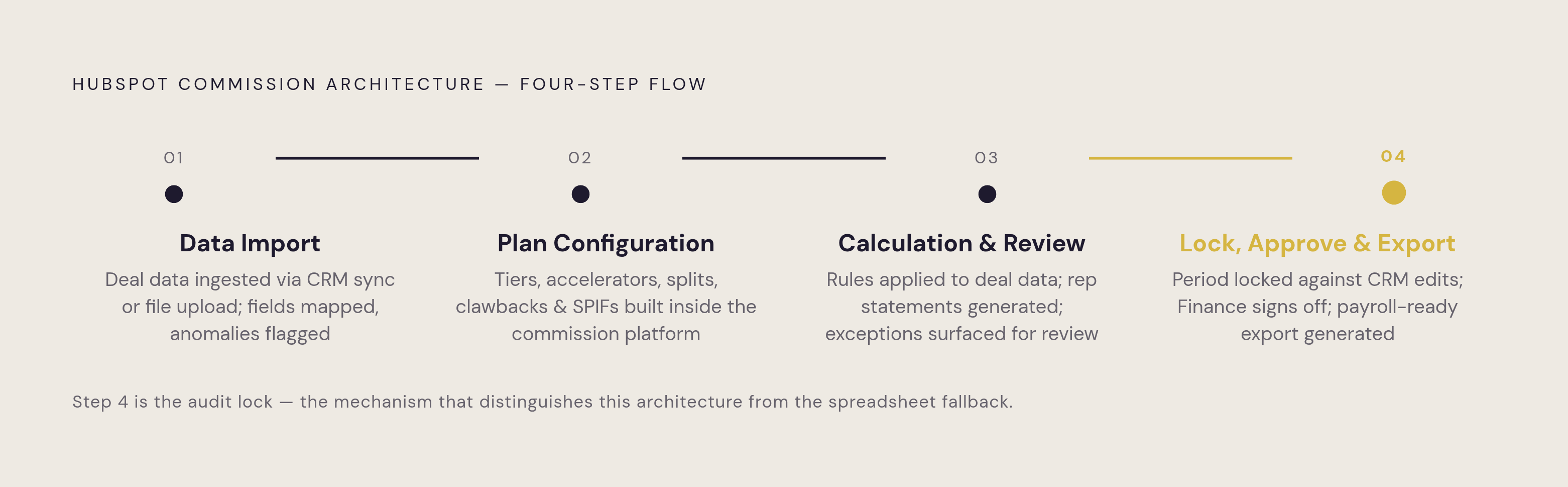
The correct architecture gives HubSpot and the commission platform distinct jobs with a defined handoff between them. HubSpot remains the authoritative source of deal data. A dedicated commission platform becomes the authoritative record for incentive calculations. Neither system tries to do the other's job.
The workflow runs in four steps. First, data import: deal data enters the commission platform through a CRM integration or a file upload, the integration maps the fields the compensation plan actually requires, and records with missing or anomalous values get flagged before any calculation runs. Second, plan configuration: the compensation plans themselves, including tiered rates, accelerators, split rules, payment triggers, SPIFs, and clawback windows, are built and maintained inside the commission platform. AI-assisted extraction from existing plan documents can speed up the initial setup of these rules, but every rule still needs human review and sign-off before the plan goes live; automation accelerates the work without replacing the approval step. Third, calculation and review: the platform applies the configured plan rules to the imported deal data, generates rep-level statements, and surfaces exceptions for a person to review before any payout is approved. Fourth, lock, approve, and export: the pay period is locked so that retroactive CRM edits cannot alter a result that has already been calculated, a manager or Finance approver signs off, and the output is exported in a payroll-ready format. The locked period combined with the logged approval is what makes the resulting payout auditable: anyone can trace it back to the underlying deal data, the specific plan version that applied, and the person who approved it.
Rep visibility runs alongside all four steps. Reps need to see their own deal-level statement detail, their quota progress, and a forecast of their earnings in something close to real time. This is the direct, practical remedy for shadow accounting, and it depends on the commission platform surfacing that data to reps themselves. The commission platform also needs downstream connections into payroll and ERP systems, and it needs to handle the cases where payment receipt, not deal close, triggers payout, pulling events from billing systems that sit entirely outside HubSpot. None of this requires rebuilding HubSpot workflows or ripping out existing configurations; a well-designed integration meets a team's data where it already lives.
Evaluating Commission Platforms That Integrate with HubSpot
The failure modes already covered point directly to the questions that matter when evaluating a platform. A connector logo on an app marketplace listing does not mean an integration can handle real plan complexity, and a platform that cannot lock periods or version plans ends up replicating the spreadsheet's core problems inside a nicer interface.
Integration depth comes first. Does the platform sync through a webhook in real time, or through polling on a lagged schedule? Does it map custom HubSpot deal properties, or only the standard fields that ship by default? How does it handle a retroactive CRM edit made after a period has already been locked? Plan logic coverage comes next: can the platform natively handle tiered rates, accelerators, multi-rep splits, payment-triggered payouts, and clawbacks, or do those cases require custom code and manual workarounds behind the scenes? Period management covers whether a pay period can actually be locked so that post-close CRM edits cannot alter an approved payout, and whether the platform keeps a version history of the plan itself so a later rule change does not reach back into closed periods.
Rep visibility is its own evaluation criterion: can reps see their own deal-level statement detail and quota progress without asking Finance to pull a report for them? That capability is the structural answer to shadow accounting, not a nice-to-have dashboard feature. Audit trail and approval workflow matter just as much: does every payout carry a log of the data that fed it, the plan version that applied, and the name of whoever approved it? Can Finance reconstruct any single payout without opening the original spreadsheet? Security is a baseline requirement rather than a differentiator at this point: encryption in transit and at rest, tenancy scoped to the organization, and a clear policy on whether customer data gets used for model training.
HubSpot's own App Marketplace lists a number of commission-focused integrations, and the evaluation work has to go past the listing itself into the specifics of field mapping, period management, and plan logic each one actually supports. Even a platform that clears every one of these criteria faces a slower problem on the other side of a go-live: trust is a lagging indicator. Reps tend to keep their shadow books running for months after the underlying system has become accurate, because the cost of being wrong about their own pay is asymmetric to them in a way no announcement can offset. Software calculates the commission. Rebuilding a rep's trust in that calculation is a separate project, one that only accumulates through consistent accuracy across multiple pay periods in a row.

